 By Eli Stanton · Published · 1400 words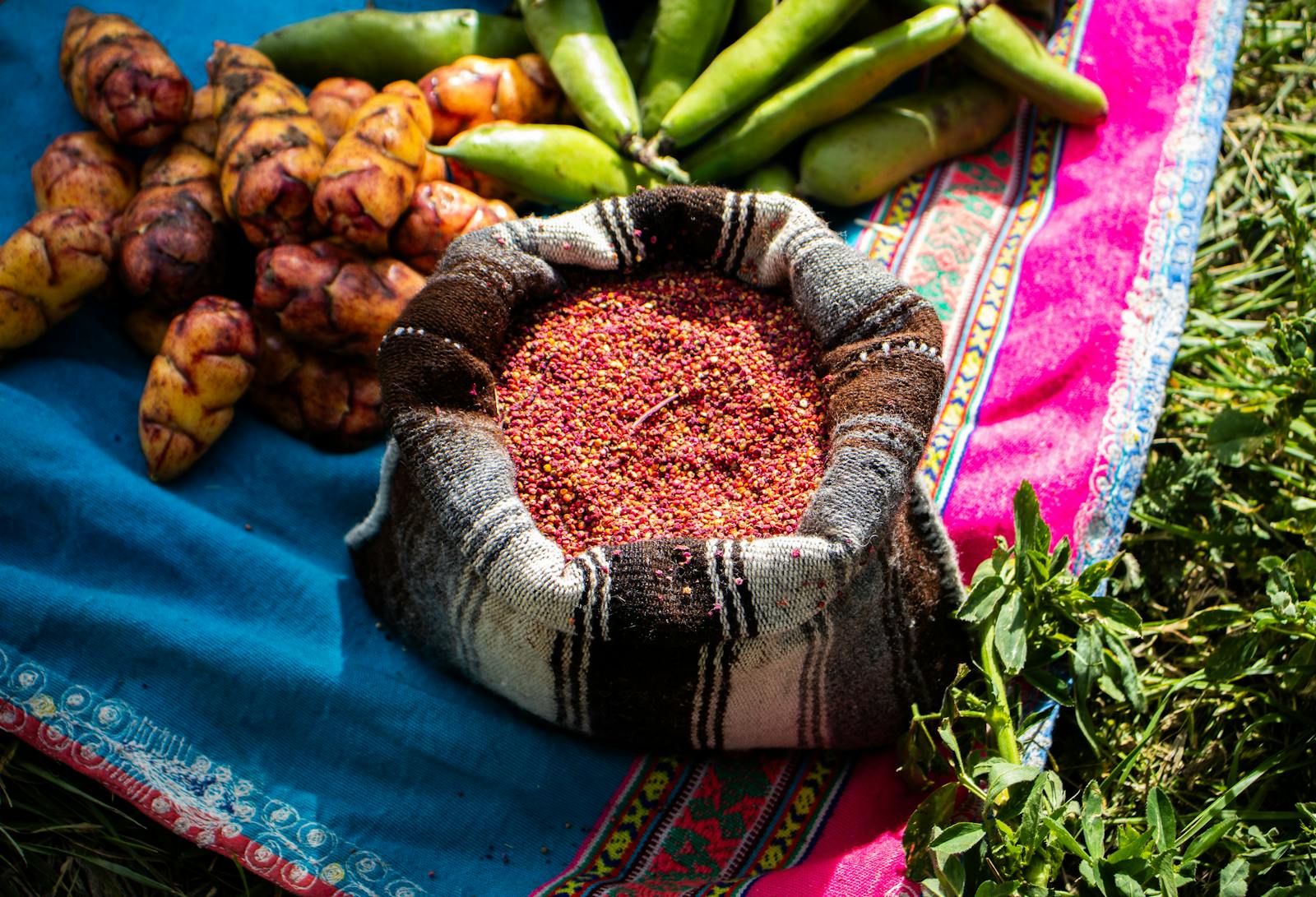
If you stand on the southern shore of Lake Titicaca on the Bolivian-Peruvian border at about 12,500 feet of elevation, you are standing where quinoa was first cultivated, somewhere between 5,000 and 7,000 years ago. The plant grew wild in the altiplano before humans got to it. By the time the Inca Empire rose in the 13th century, quinoa was already so integral to Andean life that the Inca called it chisaya mama, “mother of all grains.” The history matters because it explains why a single Spanish royal decree in the 1500s nearly wiped quinoa off the global menu for 400 years, and why it took until the 1980s for the grain to make its way back.
This is a deeper story than most quinoa profiles tell. I have eaten my way through highland Peru and the salt flats of Bolivia where pure-strain quinoa is still grown the old way, and what struck me is how recently this grain was a rural-poverty crop. The arc of quinoa is a study in how colonialism reshapes what gets to be food.
Quick answer: Quinoa was first cultivated 5,000 to 7,000 years ago in the Andean highlands around Lake Titicaca, where the Inca called it chisaya mama, "mother of all grains." Spanish colonizers suppressed it in the 1500s to push wheat and barley, and it survived mainly in remote highland villages until a revival in the 1970s and 1980s carried it into the global pantry.
Where did quinoa originate?
The botanical record places quinoa’s domestication in the Andean highlands around Lake Titicaca, with carbon-dated remains at archaeological sites going back at least 5,000 years and some genetic evidence suggesting up to 7,000. Chenopodium quinoa (its scientific name) is a hardy pseudocereal, related to spinach and beets, that thrives at altitudes where corn and wheat cannot survive. It tolerates frost, drought, and salty soil. The plant evolved specifically for the brutal conditions of the Andean altiplano, which is what made it indispensable to the people who lived there.
Quinoa was not just food. It was foundation. Pre-Inca Andean civilizations (Tiwanaku, Wari) built population centers around quinoa cultivation. By the time the Incas consolidated the region in the 1400s, quinoa was second only to corn in importance, and arguably more important nutritionally because it grew where corn could not.
What did the Incas call quinoa?
The Quechua name was kinwa (sometimes written kiwicha in older texts, though kiwicha now usually refers to amaranth, a sibling pseudocereal). The honorific title was chisaya mama, “mother of all grains.” Each year the Inca emperor planted the first quinoa seed of the season with a golden hoe during a state ceremony at Cuzco. The grain had religious as well as agricultural significance, and that fact, more than any other, is what got it banned.
Why was quinoa suppressed by the Spanish?
When the conquistadors arrived in 1532, they encountered an Inca religious system that wove quinoa into nearly every ceremony: harvest festivals, military rituals, ancestor worship. Spanish missionaries documenting the Inca described quinoa-based offerings to the sun god Inti and to huacas (sacred objects). The Catholic Church’s response was both theological and economic: ban the pagan grain, replace it with Christian wheat and barley.
A series of colonial decrees in the 1500s prohibited quinoa cultivation in major valleys, destroyed quinoa stores in Cuzco and other administrative centers, and pushed indigenous farmers toward European cereals. The official justification was eliminating pagan religious practice. The underlying motivation was establishing a wheat economy that funneled grain to Spanish colonists.
It mostly worked. Quinoa survived only in remote highland villages where Spanish administrative reach was weakest, mainly in southern Peru, Bolivia, and northern Argentina. For 400 years, from roughly the late 1500s to the late 1900s, quinoa was a subsistence crop grown by indigenous farmers for indigenous consumption, dismissed by urban Latin Americans as comida de los pobres (“poor people’s food”). My friends in Lima who grew up middle-class in the 1970s remember their parents refusing to serve quinoa.
When did quinoa become popular again?
The revival started slowly in the 1970s with Andean agricultural research stations beginning to catalog and breed indigenous varieties. NASA picked it up in the 1980s as a candidate crop for long-duration space missions because of its nutritional density (it is a complete protein, rare among plants). Western health-food markets noticed in the late 1990s.
The breakthrough years were 2007-2013. Demand from North America and Europe roughly tripled. Bolivia and Peru, the two largest producers, saw quinoa prices increase by a factor of 7 between 2000 and 2013. The United Nations declared 2013 the International Year of Quinoa, citing both nutritional value and resilience to climate change. It was the first time the UN had named an International Year for a food crop in 25 years.
Did Western demand hurt Andean farmers?
This is the part most quinoa history posts leave out, and it is the most interesting part. The 2013-era spike created a real ethical debate. Quinoa prices rose so high that many Andean families could no longer afford to eat their own staple grain. Some studies showed that domestic quinoa consumption in Peru and Bolivia fell sharply during the price boom, with families substituting cheaper imported rice and pasta. The “quinoa is starving the people who grew it for 5,000 years” framing became a recurring health-magazine headline around 2013.
The reality is more complicated. A 2016 World Bank analysis showed that higher prices also raised farmer incomes substantially. Quinoa-growing households in Bolivia saw consumption of other foods rise as their cash income grew. Domestic quinoa eating dropped, but overall caloric and nutritional intake went up. The picture varied a lot by region.
Prices have since stabilized closer to mid-2000s levels (production scaled up, including in Europe and the US), and the ethical debate has softened. But it is worth remembering that what shows up on an American kitchen counter at $9 a pound was, within recent memory, the staple food of an entire civilization that the Spanish tried to erase.
How is quinoa grown today?
Bolivia and Peru still produce roughly 90% of the world’s quinoa, with Ecuador, the United States, Canada, and France adding smaller shares. The most prized variety, quinoa real (royal quinoa), grows only at extreme altitude on the Bolivian salt flats near the Salar de Uyuni. It has larger grains and a richer flavor than the lowland varieties grown in commercial agriculture elsewhere, which is what most of the organic white quinoa on grocery shelves actually is.
For a practical cooking method, our how to cook quinoa in a rice cooker guide covers the basics, and our quinoa vs rice comparison settles how the Andean grain stacks up against the staple it most often replaces. If you want to compare quinoa with its sister Andean pseudocereal, the how to cook amaranth post applies the same simmer logic to a closely related grain.
The next time you eat a quinoa bowl, the seeds in front of you trace back to women on the shores of Lake Titicaca, 5,000 years ago, selecting the largest grains from wild Chenopodium plants and planting them again. The Incas refined it into chisaya mama. The Spanish nearly killed it. It came back. There are not many foods with that kind of biography.
Frequently asked questions
Why did the Incas call quinoa the “mother grain”?
They called it chisaya mama, “mother of all grains,” because it was the staple that fed the empire where corn could not grow, thriving at high altitude through frost, drought, and salty soil. It also carried religious weight: the emperor planted the season’s first quinoa seed in a state ceremony.
Is quinoa from Peru or Bolivia?
Both. Quinoa was domesticated around Lake Titicaca, which straddles the Peru-Bolivia border, and the two countries still grow roughly 90 percent of the world’s supply today.
Was quinoa really banned by the Spanish?
Yes. Colonial decrees in the 1500s prohibited quinoa cultivation in major valleys and destroyed stored grain, partly to stamp out its role in Inca religion and partly to build a wheat economy. It survived only in remote highland villages for some 400 years.
Stock up on Quinoa
See our hand-picked Quinoa, from flour to whole grain, with the brands worth buying.
Shop Quinoa →