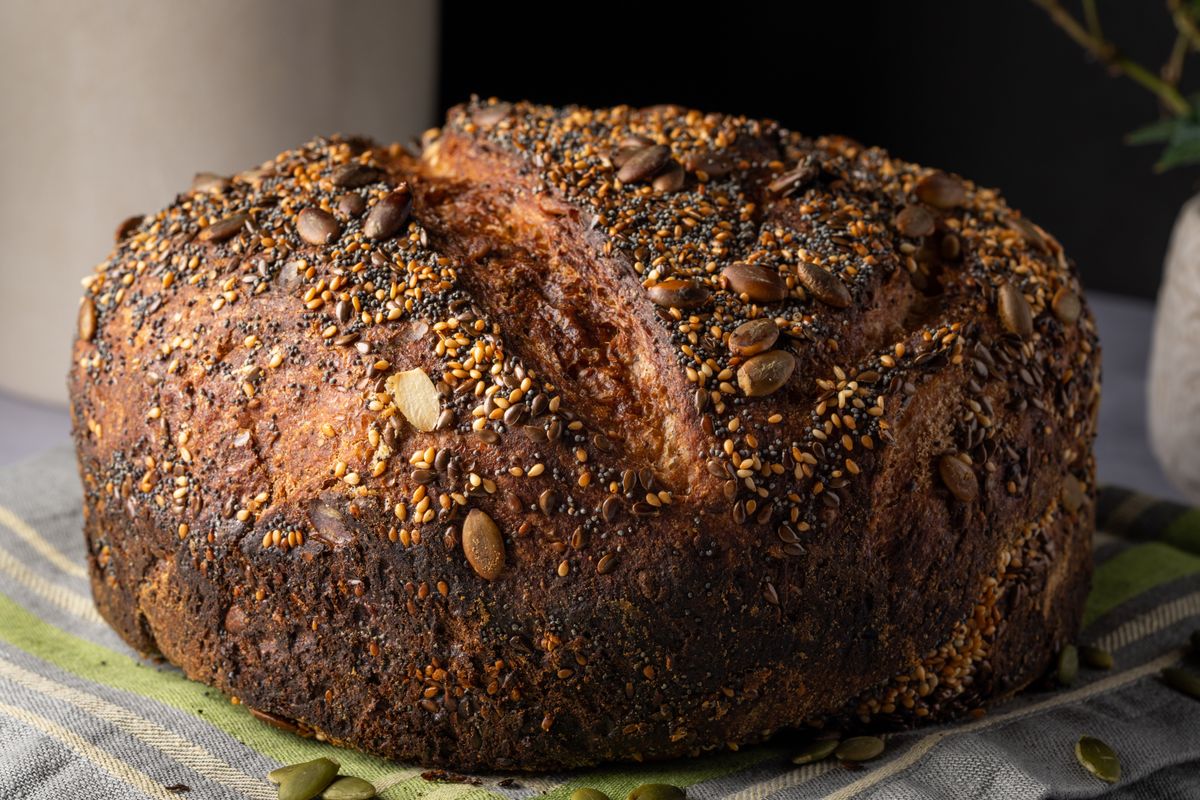
This ezekiel bread recipe starts not with flour but with a verse. Ezekiel 4:9 instructs the prophet to take wheat, barley, beans, lentils, millet, and spelt, put them in one vessel, and make bread. Whoever wrote that line was describing, without knowing it, a nutritionally shrewd loaf: cereals and legumes together supply all nine essential amino acids, which neither does alone. The modern version sprouts those same grains and legumes before grinding them into a dough, and the result is dense, faintly sweet, deeply nutty, and unlike any loaf you buy pre-sliced. Here is how the bread actually comes together, why the sprouting matters, and the one thing people always get wrong about whether it is gluten-free.
Quick answer: Ezekiel bread is a flourless loaf made from sprouted whole grains and legumes, based on the recipe in Ezekiel 4:9: wheat, barley, spelt, millet, lentils, and beans. You soak and sprout the seeds for two to three days, grind the wet sprouts into a paste, then mix, rise, and bake it like a dense loaf. Pairing grains with legumes gives a complete protein and a lower glycemic response than white bread. It contains wheat, barley, and spelt, so it is not gluten-free.
What is Ezekiel bread?
Ezekiel bread is a flourless bread made from sprouted whole grains and legumes, named for the Old Testament recipe in Ezekiel 4:9. Instead of milling grain into flour, you germinate the whole seeds until they sprout, then grind the wet sprouts into a coarse paste that becomes the dough. The classic blend is wheat, barley, spelt, millet, lentils, and beans. The commercial loaves you see in the freezer aisle follow the same idea, but making it at home lets you control the ratio and skip the additives. It is a bread with a genuinely ancient pedigree, rooted in the same Near Eastern grain culture that gave us the first cultivated wheats.
Why do you sprout the grains?
Sprouting is the whole point, not a garnish. When a grain or legume germinates, enzymes wake up and begin converting stored starch and protein into the simpler sugars and amino acids the sprout would use to grow. For the eater, that means three things: some of the starch is pre-digested, so the bread has a gentler effect on blood sugar than white bread; minerals like iron and zinc become more available as sprouting breaks down phytic acid that otherwise binds them; and the protein is both more plentiful and more complete. Pairing cereal grains with legumes, exactly as Ezekiel 4:9 does, closes the amino-acid gap, since the lysine that wheat lacks is abundant in lentils and beans. The Whole Grains Council has a good primer on why intact and sprouted grains outperform refined flour.
What goes in Ezekiel bread?
Wheat, spelt, barley, and millet, plus lentils and beans. Those are the traditional six, in rough order of volume, plus the yeast that makes a home loaf actually rise and the olive oil, honey, and salt that round it out.
- 1/2 cup (95 g) hard red wheat berries
- 1/2 cup (90 g) spelt berries
- 1/2 cup (100 g) hulled barley (not pearled; pearled barley will not sprout)
- 1/2 cup (100 g) whole millet
- 1/4 cup (50 g) green or brown lentils (they sprout fast)
- 1/4 cup (50 g) dried adzuki or pinto beans (they soak longest)
- 2 tsp active dry yeast, bloomed in 1/4 cup (60 ml) warm water
- 2 tbsp (30 ml) olive oil
- 2 tbsp (40 g) honey
- 1.5 tsp (8 g) fine salt
Each ingredient earns its place: the wheat and spelt bring the gluten backbone, barley the body, millet a tender crumb and a mild corn-like note, and the lentils and beans the complete-protein pairing that makes the verse nutritionally shrewd. For sprouting you must start with whole, un-hulled or hulled (never pearled or rolled) grains: a bag of spelt berries and whole millet are the two easiest to source and the most reliable sprouters.
How do you make Ezekiel bread?
Soak and sprout the grains and legumes, grind the wet sprouts into a sticky paste, mix that paste with the yeast, oil, honey, and salt, let it rise twice in a 9x5 loaf pan, and bake.
- Sprout the grains and legumes. Combine equal parts hard red wheat berries, spelt berries, hulled barley, and millet with a smaller amount of lentils and beans. Rinse, cover with water, and soak overnight. Drain, then rinse two or three times a day for two to three days until small tails appear. A wide-mouth sprouting jar makes this far less fiddly than a sieve, since the mesh lid lets you rinse and drain without ever tipping the grain out.
- Grind the sprouts. Drain the sprouts well and pulse them in a food processor (or run them through a grain mill’s coarse setting) into a thick, sticky, cohesive paste. This wet mash is your dough base, standing in for flour.
- Mix the dough. Combine the ground sprouts with olive oil, honey, salt, and yeast bloomed in a little warm water. Knead until it holds together as a heavy, tacky mass. Add a spoonful of water or a little wheat flour only if it will not come together.
- First rise. Cover the bowl and let it rise in a warm spot until visibly puffed, about 45 to 60 minutes. It will never double like a flour dough; look for a 30 to 50 percent increase.
- Shape and second rise. Press the dough into a greased loaf pan, smooth the top, and let it proof again for 30 to 45 minutes.
- Bake. Bake at 350°F for 45 to 55 minutes, until the internal temperature reads about 200°F and the loaf sounds hollow. Cool completely before slicing, since the dense crumb sets as it cools.
One batch fills a standard loaf pan and slices best the next day, thin, for toasting.
Is Ezekiel bread gluten-free?
No, and this is the most common misconception about it. Because Ezekiel bread is marketed as a health food, people assume it is safe for celiac disease or gluten sensitivity. It is not: wheat, barley, and spelt are all gluten-containing grains, and sprouting does not remove gluten. If you need a genuinely gluten-free loaf, this is the wrong recipe. For a full breakdown of which grains carry gluten and which do not, see our guide on is barley gluten-free, and if you bake often it is worth understanding the best flour for sourdough starter as a comparison point for how sprouted versus milled grain behaves.
Is Ezekiel bread healthier than regular bread?
For most people, yes, though “healthier” is doing some work. Compared with white sandwich bread, sprouted Ezekiel bread has more fiber, more complete protein, more available minerals, and a lower glycemic response, per the USDA FoodData Central entries for sprouted-grain products. The trade-off is that it is denser, chewier, and more perishable, and it does not do the airy sandwich thing well. Think of it as closer to a nutrient-dense flatbread than a fluffy loaf. If you want most of that whole-grain character in something that still slices like sandwich bread, wheat berry bread folds cooked whole kernels into an ordinary soft loaf instead of replacing the flour entirely. And if you like the deep, seedy character, the spelt and millet in the blend are the two grains worth exploring on their own next.
How should you store it?
Ezekiel bread is more perishable than flour bread because it has no preservatives and a high moisture content, so treat it like fresh produce. Keep it in the fridge for up to a week, or slice and freeze it, pulling slices straight to the toaster. Do not leave it on the counter for more than a day or two, especially in a warm kitchen, or it will mold. The dense sprouted crumb is at its best toasted, which crisps the outside and brings out the nuttiness of the grain.
Frequently asked questions
Can you make gluten-free Ezekiel bread?
Not in the traditional form, because wheat, barley, and spelt are core to the Ezekiel 4:9 blend and all contain gluten. You can build a loaf in the same sprouted spirit using only gluten-free grains and legumes, such as millet, sorghum, buckwheat, quinoa, lentils, and beans, but it is a different bread. Our gluten-free grains guide lists the seeds that work.
Is Ezekiel bread vegan?
The commercial loaves usually are, but this homemade recipe uses honey. Swap the honey for maple syrup or agave and it becomes fully vegan, with no change to the method. Everything else in the blend, the sprouted grains, legumes, oil, salt, and yeast, is already plant-based.
Why is my Ezekiel bread so dense?
Because it is supposed to be. With no flour and only the weak gluten of sprouted wheat and spelt, the dough rises 30 to 50 percent rather than doubling, so the crumb is naturally dense, moist, and close-textured. That is the character of sprouted-grain bread, not a mistake; slice it thin and toast it to show it at its best.
Get the jar that does the sprouting
A wide-mouth jar with a stainless mesh lid turns three days of rinsing into a ten-second job. It is the one piece of kit this loaf genuinely needs.
Shop sprouting jars →Sprout your own grains
See the whole spelt, barley, and millet worth buying to bake a proper Ezekiel loaf, plus the brands we trust.
Shop spelt →