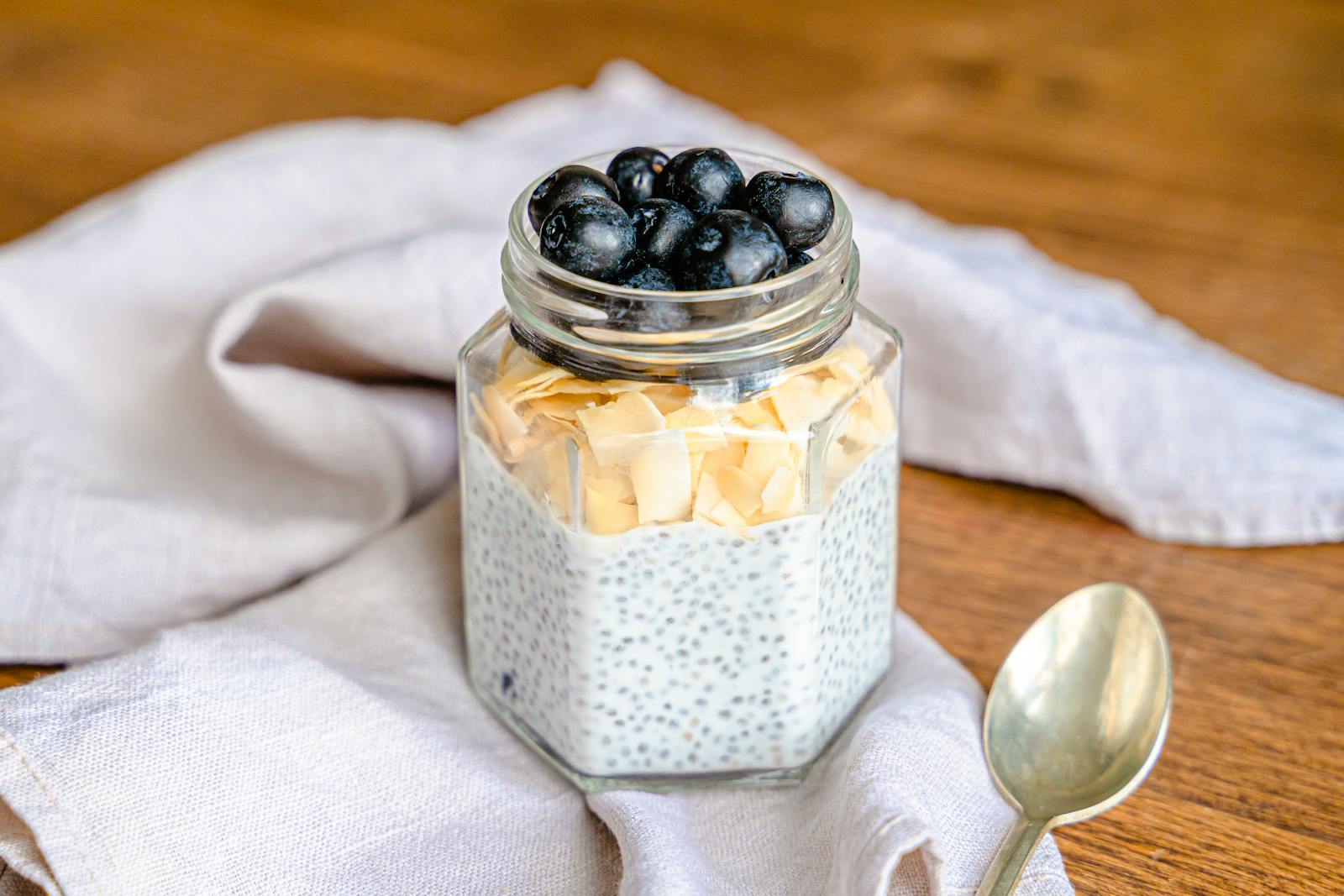
Almost every chia pudding failure comes down to one number: the ratio. Get the chia pudding ratio right and you get a thick, spoonable, tapioca-like set. Get it wrong and you get either a thin slurry or a stiff paste. The reliable starting point is 1 part chia seeds to 6 parts liquid by volume, which usually means about 3 tablespoons of chia to 1 cup of milk. From there you can nudge it thicker or looser to taste. Chia is naturally gluten-free, so this is a safe, easy make-ahead breakfast for a gluten-free kitchen.
The reason the ratio matters so much is physical. Each chia seed can absorb several times its weight in liquid, forming a gel around itself, so small changes in the seed-to-liquid balance have an outsized effect on the final texture.
Quick answer: The reliable chia pudding ratio is 1 part chia seeds to 6 parts liquid by volume, which is about 3 tablespoons of chia per 1 cup of milk. That sets into a thick, spoonable, tapioca-like pudding in 2 hours, though overnight is best. Use 1:4 for a denser set or 1:8 for a drinkable one, and always stir once, wait 5 minutes, then stir again to stop clumping. Chia is naturally gluten-free.
What is the best chia pudding ratio?
1 part chia to 6 parts liquid, about 3 tablespoons of chia per cup, for the classic spoonable set. The exact ratio depends on the texture you want, but all the useful ones sit in a narrow band.
| Texture | Chia to liquid | Per cup of liquid |
|---|---|---|
| Thick and dense | 1 : 4 | 4 tbsp chia |
| Classic spoonable (recommended) | 1 : 6 | ~3 tbsp chia |
| Loose, drinkable | 1 : 8 | 2 tbsp chia |
If you are new to chia pudding, start at 1 to 6. It sets into the texture most people picture when they think of chia pudding, and it is forgiving.
How do you make chia pudding?
Stir 3 tablespoons of chia seeds into 1 cup of milk (roughly the recommended 1:6 ratio), stir again after 5 minutes to break up clumps, and chill for at least 2 hours, ideally overnight. Here is the default single serving.
- 3 tbsp (36 g) chia seeds
- 1 cup (240 ml) milk, dairy or plant
- 1 tsp maple syrup (optional)
- 1/2 tsp vanilla extract (optional)
- Fruit, nuts, or nut butter, to top
- Add your chia seeds and liquid to a jar at a 1 to 6 ratio (3 tablespoons chia, 1 cup milk is the easy default).
- Add a little sweetener and vanilla if you like: a teaspoon of maple syrup and a splash of vanilla go a long way.
- Stir well, wait 5 minutes, then stir again. This second stir is the step people skip, and it is what prevents clumping. The first stir disperses the seeds; the second breaks up the clumps that form as they start to gel.
- Cover and refrigerate for at least 2 hours, ideally overnight.
- Stir before serving and top with fruit, nuts, or nut butter.
How long does chia pudding take to set?
It is mostly set within 2 hours, but the texture keeps improving up to about 6 hours, which is why overnight is ideal. If yours still seems loose after 2 hours, give it more time before adding liquid. The gel continues to firm up in the fridge, and over-correcting early is the most common cause of a stiff, dry pudding the next morning.
Why is my chia pudding not thickening?
Too much liquid, skipping the second stir, or not enough chilling time. If it stays runny, one of these three usually went wrong.
- Too much liquid. The most common cause. Recheck your ratio against the table above and add another tablespoon of chia rather than waiting in vain.
- You did not stir twice. Undispersed seeds clump together and leave the surrounding liquid thin. Stir, wait 5 minutes, stir again.
- Not enough time. Two hours minimum. Cold slows the gelling, so a freshly mixed jar straight from a cold fridge needs the full window.
To rescue a runny batch, stir in another half-tablespoon of chia and give it 30 more minutes. To loosen an over-thick one, stir in a splash of milk.
How much chia should you eat a day?
A standard serving is about 2 to 3 tablespoons of dry chia, which is also roughly what goes into one portion of pudding. That delivers a meaningful dose of fiber and plant-based omega-3 (ALA) without overdoing it. Because chia is so high in fiber, eating large amounts suddenly can cause bloating, so it is sensible to start with one serving a day and always eat it fully hydrated, as in pudding, rather than dry. General nutrition figures are available through USDA FoodData Central.
Is chia pudding actually good for you?
For the most part, yes, with realistic expectations. Chia is genuinely rich in fiber, provides the plant omega-3 ALA, and adds a little protein and calcium, a profile the Harvard T.H. Chan School of Public Health describes favorably. The honest caveats: the ALA in chia converts to the active omega-3s EPA and DHA only inefficiently in the body, so chia is not a full substitute for fish oil, and a pudding made with sweetened milk and lots of syrup is still a sugary breakfast. Keep the toppings sensible and chia pudding is a strong, fiber-dense way to start the day.
What to make next
Once you have the ratio down, chia pudding is endlessly variable: cocoa powder for chocolate pudding, blended berries for a fruit layer, or coconut milk for a richer set. If you like make-ahead breakfasts, overnight oats run on the same fridge-overnight logic and pair well with chia in the same jar.
For more on the seed itself, see our chia profile, and if you are building a gluten-free pantry, amaranth is another tiny powerhouse worth keeping around. Curious where these ancient seeds come from? Our history of quinoa traces one such story, and for the gluten-tolerant, the emmer versus einkorn guide covers two ancient wheats at the other end of the spectrum.
Frequently asked questions
Is chia pudding gluten-free?
Yes. Chia seeds are the seed of a flowering mint relative, not a cereal grain, so they contain no gluten, and a pudding of chia, milk, and fruit is naturally gluten-free. Check that any added toppings or flavourings are certified if you are strict, and see our gluten-free grains guide for a fuller pantry list.
Can you make chia pudding with water instead of milk?
Yes, but it will be thinner and less creamy. Water sets the gel just as well, so the ratio does not change, but you lose the richness milk gives. For a middle ground, use half water and half a plant milk, or blend in a spoonful of nut butter for body.
How long does chia pudding last in the fridge?
A sealed jar of plain chia pudding keeps for about 5 to 7 days, which makes it ideal for meal prep. Add fresh fruit and nuts only when you serve, since toppings soften and weep if they sit in the pudding for days.
Stock up on Chia
See our hand-picked Chia, from flour to whole grain, with the brands worth buying.
Shop Chia →