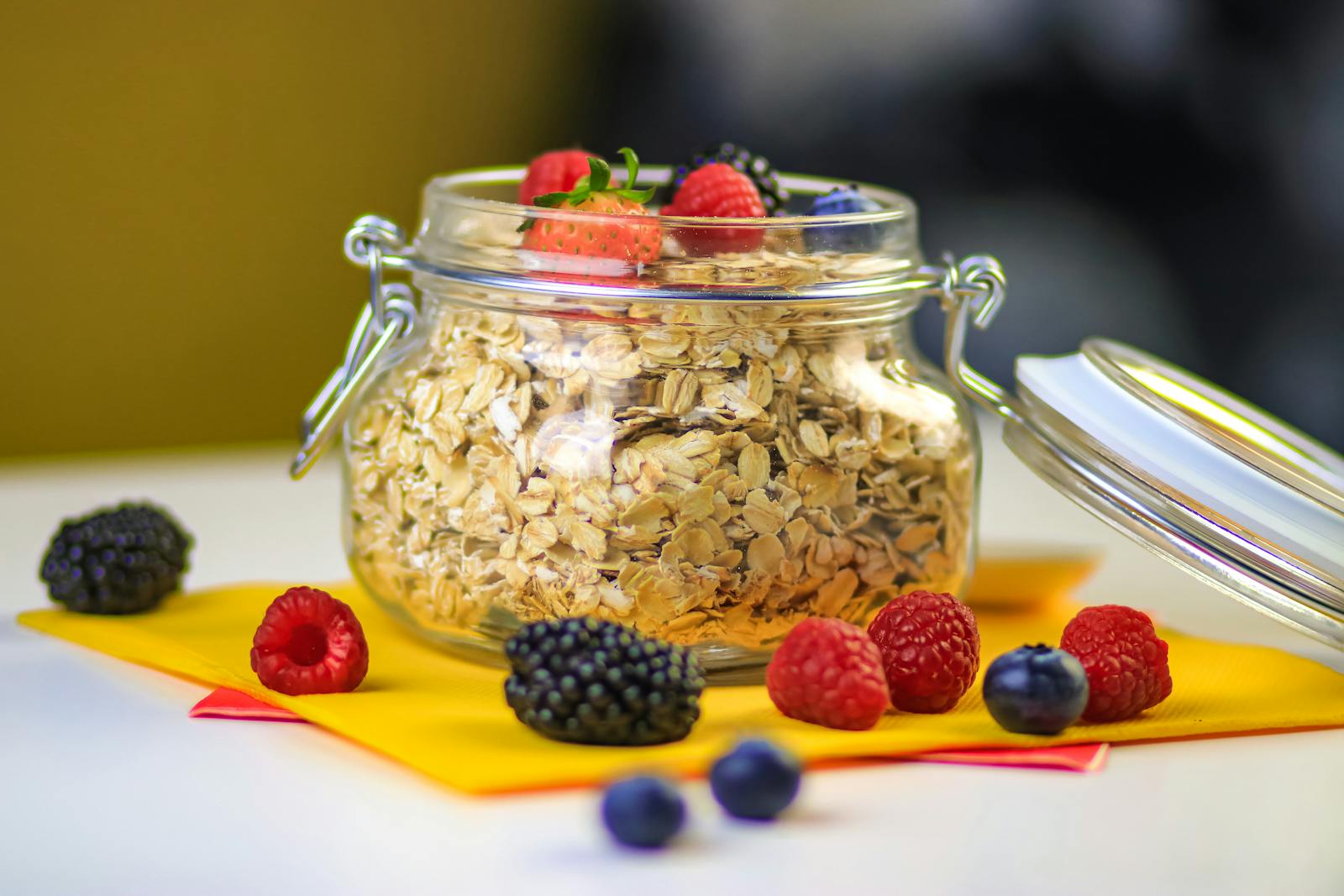
In the Highland croft kitchen where I learned to cook, overnight oats were called soaked brose: the old habit of pouring buttermilk over rolled oats before bed so breakfast was ready before the fire was lit. The modern Instagram version with mason jars and chia seeds is the same idea wearing better clothes. If you’ve ever stood over a hot oatmeal pot wondering why anyone would invent this when cold oats turn just as creamy with no cooking at all, you’ve already grasped the appeal.
Here is the method I make four mornings a week, the ratio worth memorising, and the four flavours I rotate through so it never gets boring.
Quick answer: Overnight oats are raw rolled oats soaked in cold liquid in the fridge until they turn creamy without cooking. Use a 1:1 ratio of rolled oats to milk, add a pinch of salt, and chill 6 to 12 hours (up to 48). Add a tablespoon of chia per half cup of oats for a thicker set, or a spoon of yogurt for richness, and use old-fashioned rolled oats, not quick or steel-cut. They are gluten-free if you use certified oats.
How long do overnight oats need to soak?
6 hours minimum, 12 ideal, 48 hours maximum. The starch in raw rolled oats absorbs cold liquid slowly, and the beta-glucan (a soluble fibre that gives oats their creaminess) needs time to swell and gel without heat. Less than 6 hours and you’ll bite into chalky kernels. Past 48 hours, the texture turns from creamy to mushy.
Most people make them at night and eat them the next morning. That’s 8-12 hours, which lands squarely in the ideal window.
The 1:1 ratio (and the only one to memorise)
The single ratio that works every time is:
1 part rolled oats : 1 part liquid
By volume. So 1/2 cup oats + 1/2 cup milk = one breakfast-sized jar. By weight: 50 g oats + 120 g milk (oats are lighter than liquid, so the gram ratio looks different).
If you want it thicker (more spoon-and-eat than slurpable), add 1 tablespoon chia seeds per 1/2 cup of oats. The chia absorbs another ~3x its weight in water and tightens the texture, the same gel that powers a proper chia pudding. If you want it richer, swap 2 tablespoons of the milk for plain yogurt.
- 1/2 cup (50 g) old-fashioned rolled oats
- 1/2 cup (120 ml) milk, dairy or plant
- 1 tbsp chia seeds (optional, for a thicker set)
- 2 tbsp plain yogurt (optional, for richness; swap in for 2 tbsp of the milk)
- Pinch of salt
- Sweetener and toppings per the flavour templates below
- Combine the oats, milk, and any chia or yogurt in a jar, with a pinch of salt.
- Stir well, screw on the lid, and refrigerate 8 to 12 hours (6 minimum, 48 maximum).
- In the morning, stir, loosen with a splash of milk if it set thicker than you like, and add your toppings.
Scale the jar to your appetite:
| Jar size | Oats | Milk | Chia (optional) | Yogurt (optional) |
|---|---|---|---|---|
| Small (snack) | 1/3 cup | 1/3 cup | 1 tsp | 1 tbsp |
| Standard | 1/2 cup | 1/2 cup | 1 tbsp | 2 tbsp |
| Hungry | 3/4 cup | 3/4 cup | 1.5 tbsp | 3 tbsp |
That’s the whole framework. Everything below is flavouring.
Are overnight oats gluten-free?
The oats themselves are. Cross-contamination at the field, the truck, and the mill is the usual issue, the same caveat we cover in detail in our oat flour pancakes post. If you have celiac disease, buy oats with the GFCO, NSF Gluten-Free, or Celiac Support Association seal. The Celiac Disease Foundation covers cross-contamination thoroughly. For non-celiac gluten sensitivity, regular oats are usually fine, but listen to your gut.
This is the same labeling situation as buckwheat: the plant itself is harmless, the supply chain isn’t.
Why do raw oats get creamy in the fridge?
Two things happen at the same time. First, the starch granules in rolled oats absorb cold liquid through hydrogen bonding. The granules swell. Second, the beta-glucan (a long, branching polysaccharide locked inside the oat cell walls) leaches into the surrounding liquid and forms a viscous gel. Heat speeds this up, which is why hot oatmeal is creamy in 5 minutes; cold takes 6+ hours but reaches the same end state.
A 2018 review in Nutrition Today summarises the beta-glucan chemistry and notes that no-cook overnight soaking preserves more of the soluble fibre intact than boiling, which is one practical health-edge of the cold method. (The dessert aisle runs on the same trick: no-bake oatmeal cookies are rolled oats set without an oven.)
For the USDA nutritional breakdown on oats: about 13g protein, 10g fiber, and significant magnesium per 100g uncooked. The cold method changes none of that.
What kind of oats work best?
Old-fashioned rolled oats, full stop. The other types all have problems.
- Quick oats: too thin, turn to porridge. Edible but mushy.
- Steel-cut oats: do not soften enough. They stay chewy and grainy even after 24 hours, so save them for a dedicated overnight steel-cut oats method instead.
- Oat groats (whole): way too dense. They need actual cooking.
- Instant oats: avoid; usually contain added sugar and milk powder.
Sprouted rolled oats work well if you can find them and are willing to pay double. And oat bran, the fibre-dense outer layer, is its own quick-cooking porridge rather than an overnight-oats base.
Four flavour templates worth knowing
After about a thousand jars, these are the four I keep coming back to.
1. Peanut butter banana
The default. Mash 1/2 a ripe banana into the base, stir in 1 tablespoon natural peanut butter and a pinch of cinnamon. Top with sliced banana and a drizzle of honey in the morning. This is the version my niece eats every day before school.
2. Apple cinnamon
Grate 1/2 small apple into the base, add 1/2 teaspoon cinnamon, 1 teaspoon maple syrup. Top with chopped walnuts and another little apple sliver. Tastes like apple pie filling.
3. Mocha
For coffee drinkers. Stir 1 teaspoon cocoa powder and 1 teaspoon instant espresso into the milk before mixing. Sweeten with 1 teaspoon maple syrup. Top with a few chocolate chips. Half breakfast, half dessert.
4. Savoury cheddar and scallion
Skip the sugar entirely. Stir in 2 tablespoons grated sharp cheddar, 1 tablespoon chopped scallion, salt and pepper. Top with a soft-boiled egg in the morning and a dash of hot sauce. Tastes like cheese grits and is shockingly good. This is the version that turns sceptics, mind you.
What are the common mistakes?
Three things go wrong most often: the wrong oats, too much liquid, and waiting too long to eat them.
- Wrong oats. Quick oats turn to paste, steel-cut stays crunchy. Stick to rolled oats.
- Too much liquid. 1:1 ratio is the sweet spot. If you go 1:1.5 or beyond, you get oat soup.
- Eating too late. Overnight oats hit peak texture at 8-12 hours. They’re still safe and tasty at 48 hours, but the texture starts breaking down past day 2. Make 3 jars on Sunday night for Monday-Wednesday, then make 3 more on Wednesday for Thursday-Saturday.
A fourth, smaller note: if your overnight oats taste flat, you need salt. A pinch in the jar before refrigerating wakes up everything else.
What else is worth eating cold?
For the broader cold-grain repertoire, our oat flour recipes roundup covers the non-overnight applications of oats. If you want a gluten-free pseudocereal alternative, see our quinoa history for context on the grain (or the quinoa grain page for the basics), then our quinoa flour post for a similar make-once-eat-cold setup using quinoa as a porridge base. And if you’re curious about how oats fit alongside the wheat-family ancient grains, our deep dive on emmer vs einkorn explains why oats sit so far apart from those: different genus entirely.
The first jar takes a couple of minutes of active work the night before. The second jar feels like a free meal. By the fifth jar, you’re a person who eats breakfast.
Frequently asked questions
Can you eat overnight oats warm?
Yes. They are designed to be eaten cold straight from the jar, but if you prefer them warm you can microwave a portion for a minute or two, stirring once and adding a splash of milk to loosen it. Warming turns them into a quick bowl of porridge, so it is a good option in winter.
Can you make overnight oats with water instead of milk?
You can, though they will be less creamy and rich. Water soaks the oats and swells the beta-glucan just fine, so the texture still works, but milk (dairy or plant, homemade oat milk included) is what makes them luscious, and if you are choosing between plant milks our oat milk vs almond milk comparison covers which one sets up creamier. A middle path is half water, half milk, or a spoon of yogurt or nut butter stirred in for body.
Are overnight oats healthy?
Yes, at their core. Rolled oats bring soluble beta-glucan fibre and protein that keep you full and steady blood sugar, and the no-cook soak preserves that fibre well. What tips them toward or away from healthy is the toppings, so lean on fruit, nuts, and seeds and go easy on added syrups and chocolate.
Stock up on Oats
See our hand-picked Oats, from flour to whole grain, with the brands worth buying.
Shop Oats →