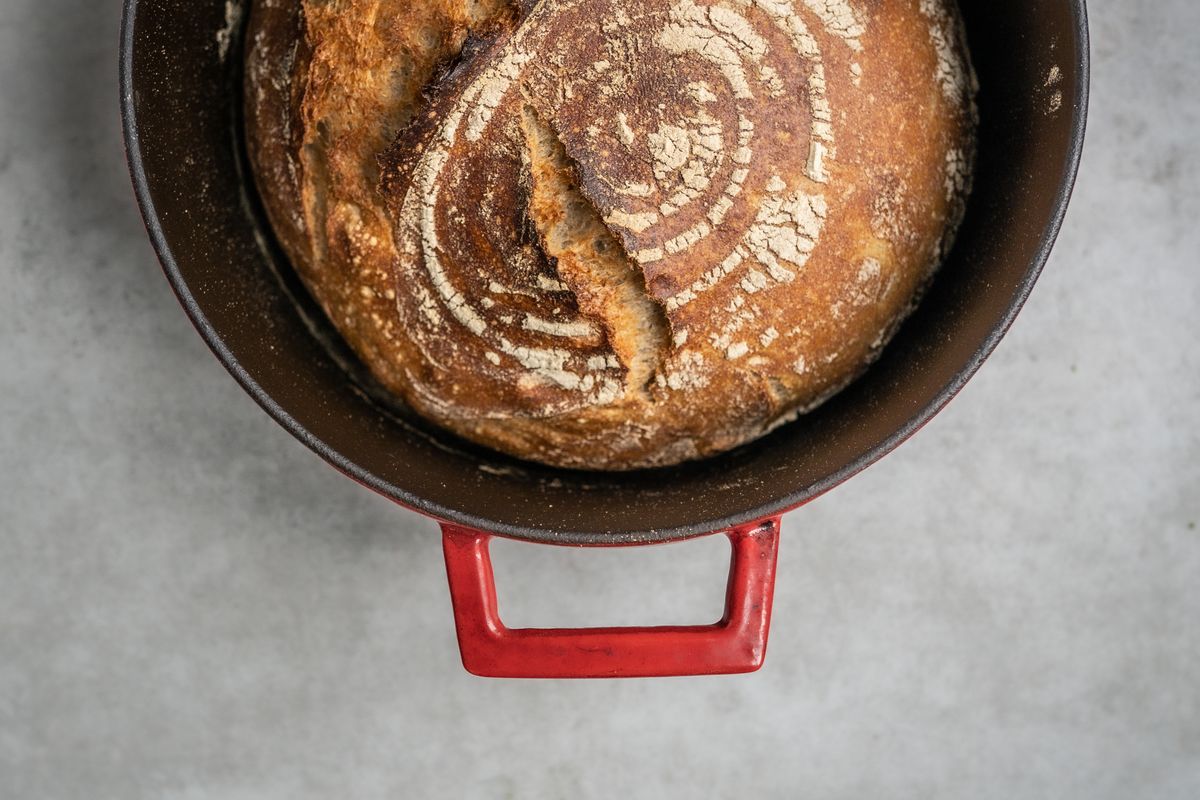
Here is the open secret behind every crackly, blistered, bakery-looking loaf on your feed: dutch oven bread is not a technique so much as a piece of physics you can buy. A heavy lidded pot turns a home oven into a professional steam-injected deck oven, and the recipe that exploits it best requires no kneading, no mixer, and about ten minutes of actual work. I have tested this method against stand mixers, proofing boxes, and $300 cookware, and the boring truth is that the cheap pot and the lazy recipe win.
Quick answer: Dutch oven bread is a no-knead loaf baked inside a heavy lidded pot, which traps the dough's own steam to give a thin, glossy, bakery-style crust and a big rise. Stir together bread flour, water, salt, and a pinch of yeast, ferment 12 to 18 hours, shape and rise 1 to 2 hours, then bake in a preheated pot at 475°F, covered 30 minutes and uncovered 15 to 20 more. A 5-to-7-quart round pot is ideal. It is a wheat loaf, so it contains gluten.
Why does a dutch oven make better bread?
Steam. A loaf’s crust sets in the first minutes of baking, and if it sets dry it goes thick, dull, and pale. Professional ovens inject steam to keep the surface soft and stretchy while the loaf springs; a dutch oven does the same thing for free by trapping the moisture the dough itself releases. Sealed under that heavy lid, the loaf bakes inside its own tiny steam room: maximum rise, thin glossy crust, and the crackle you cannot get on an open baking sheet. Take the lid off for the last stretch and the dry heat browns everything deeply. That is the entire trick.
How do you make no-knead dutch oven bread?
Stir four ingredients into a shaggy dough, let it ferment 12 to 18 hours, shape it and let it rise 1 to 2 hours, then bake it in a preheated dutch oven, covered first and uncovered to finish. This is the no-knead method Jim Lahey made famous in 2006, and time does all the work kneading would have done.
- 400 g (3 1/3 cups) bread flour
- 300 g (1 1/4 cups) cool water (75% hydration)
- 8 g (1 1/3 tsp) fine salt
- 1 g (1/4 tsp) instant yeast
- Variant: swap 120 g of the flour for whole spelt or rye (30%) for a heritage loaf
- Mix. Stir the flour, salt, and yeast together, add the water, and mix with a spatula until no dry flour remains. It will look shaggy and wet; that is correct. Cover the bowl.
- Bulk ferment 12 to 18 hours at room temperature. Mix it after dinner, bake before lunch. The surface should be bubbly and the dough roughly doubled, loose, and smelling faintly beery.
- Shape. Scrape the dough onto a floured counter, fold it over itself into a rough ball, and set it seam-side down on a square of parchment. Rest it 1 to 2 hours, until puffy.
- Preheat the pot. For the last 30 minutes of that rise, heat the oven to 475°F with the covered dutch oven inside. A cold pot costs you oven spring; a screaming-hot one is the point.
- Bake covered, 30 minutes. Lower the dough into the pot by the parchment corners, lid on. Do not peek; the steam you would release is the crust you came for.
- Bake uncovered, 15 to 20 minutes, until the crust is deep chestnut brown, darker than feels polite. Cool on a rack for a full hour before slicing; a hot loaf is a gummy loaf.
What size dutch oven is best for bread?
A 5-to-7-quart round pot is the sweet spot for a standard loaf: wide enough for the boule to spread, tall enough for spring, small enough to concentrate steam. Our what size Dutch oven for bread guide breaks the sizing down loaf by loaf if you want the full picture. Beyond size, the honest buying advice is short. You do not need the luxury brands; a loaf cannot read logos. The Lodge 6-quart enameled dutch oven is the one I recommend first: 6 quarts, smooth enamel that releases parchment cleanly, and it doubles for every stew and braise in your life. The clever budget alternative is a cast iron combo cooker, where the shallow skillet half becomes the base, so you slide the dough in flat instead of dropping it into a deep, knuckle-burning well. Bare cast iron works exactly as well as enamel for bread; enamel just cleans up easier after everything else. Our best Dutch oven for sourdough guide lays out the reasoning before you spend, and our Dutch oven picks page compares five pots from a budget combo cooker to a Le Creuset.
Can you use a sourdough starter instead of yeast?
Yes, and the pot does not care what raised the dough. Swap the 1/4 teaspoon of yeast for about 100 g of active, recently fed starter, reduce the water slightly (a starter is half water itself), and expect the bulk ferment to run shorter, more like 8 to 12 hours depending on your kitchen’s warmth. If you do not have a starter yet, our 7-day starter method gets you one for the cost of some rye flour, and our whole grain sourdough bread guide is the full sourdough-native recipe once it is alive. The dutch oven technique, preheat, lid on, lid off, is identical either way.
Can you bake no-knead bread without a dutch oven?
Yes, with a workaround for the steam. Bake the loaf on a preheated baking stone, steel, or heavy sheet pan, and create steam by sliding a metal tray of boiling water onto the oven floor for the first 20 minutes (then remove it to let the crust brown). Any deep oven-safe pot with a tight lid also works: a stockpot, a deep sauté pan, even a covered roasting pan. The crust will be a shade less dramatic than the dutch oven version, and the method is a shade more fiddly, but the bread is still leagues beyond an uncovered bake.
Why is my dutch oven bread pale, flat, or gummy?
Pale means the lid came off too late or the oven ran cool; flat usually means an under-preheated pot or an over-fermented dough; gummy means it was sliced warm. The fixes, problem by problem: for a pale crust, pull the lid at 30 minutes and check that the oven really holds 475°F; for a flat loaf, give the pot its full 30-minute preheat and watch the dough rather than the clock in hot weather (12 hours can be plenty in July); for a gummy crumb, give the finished loaf its full hour of cooling, since the crumb keeps setting long after the oven. For a deeper, darker take on the same principles, a 30% rye version of this loaf bakes beautifully in the same pot; our rye flour guide covers what that swap changes, and spelt or rye both slot into the heritage variant in the card above.
Where to go from here
Once the basic loaf is boring (a good problem), the same pot bakes our ancient grains bread blend, and the starter route opens up everything in the whole grain sourdough playbook. And if you would rather a machine handled the kneading and weekday loaves, our bread machine recipes guide and bread machine picks cover that path. One pot, ten minutes of work, and the physics does the rest. The bakery was never the hard part.
Frequently asked questions
Is dutch oven bread gluten-free?
No. The standard recipe is built on bread flour, and the heritage variant uses spelt or rye, so all of them contain gluten and are not safe for celiacs. The dutch oven itself is just a baking method, though, so you can bake a gluten-free loaf in it using our gluten-free sourdough bread recipe instead.
Do you need parchment paper for dutch oven bread, and will it burn?
Parchment is the easy way to lower wet dough into a screaming-hot pot without burning your hands or deflating the loaf, and it lifts the baked bread straight out. It will not catch fire at 475°F, since baking parchment is rated to around 450 to 500°F; the edges may brown or curl, which is harmless. If you would rather skip it, dust the hot pot with semolina or fine cornmeal.
What is the best flour for dutch oven bread?
A strong bread flour, because its higher protein builds the gluten that traps steam and gives a tall, chewy loaf with an open crumb. All-purpose flour works but bakes a little denser. For a heritage version, swap up to 30 percent of the bread flour for whole spelt or rye and keep the rest as bread flour for structure.
Get a Dutch oven
The lidded pot is what makes the crust. A 6-quart enameled one is the everyday pick; a cast-iron combo cooker is the cheaper route in.
Shop Dutch ovens →Bake it with heritage flour
See our hand-picked spelt, from flour to whole grain, with the brands worth buying.
Shop spelt →