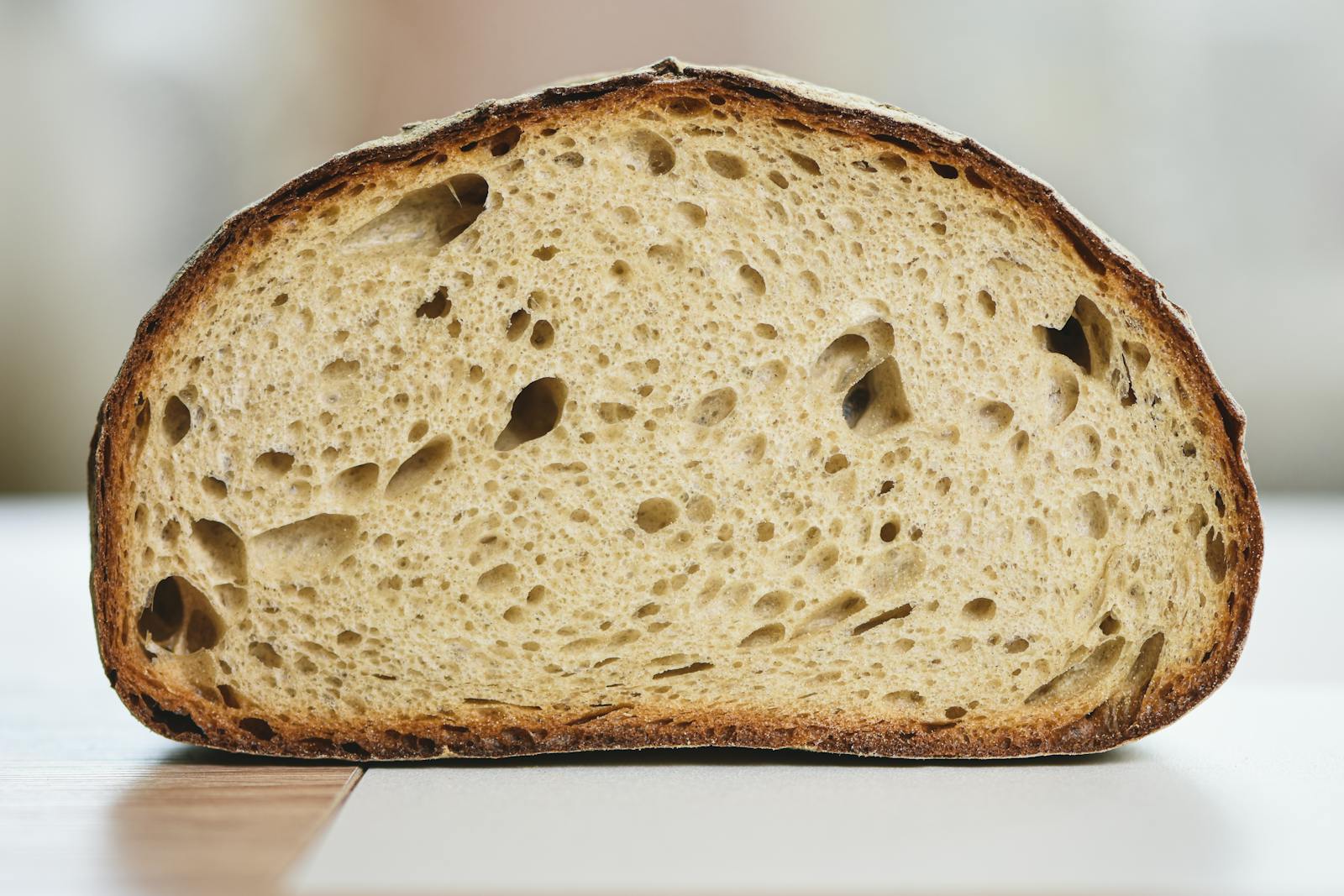
I get this question almost weekly from readers who have heard, somewhere on social media or from a well-meaning friend, that sourdough bread is gluten free because fermentation “breaks down the gluten”. I wish that were true. The science is more interesting and, for anyone with celiac disease, more important to get right than the trend cycle would have us believe.
The short answer: traditional sourdough made from wheat, rye, or barley flour is not gluten free, and is not safe for people with celiac disease. That is the line the Celiac Disease Foundation holds, and it is the line every reputable dietitian holds. The longer answer involves enough nuance about fermentation, FODMAPs, and the specific 20 parts-per-million threshold the FDA uses that the topic deserves a proper explainer rather than a tweet.
I trained in nutritional biochemistry before I started writing about grain, and the sourdough-gluten conversation is one of the cleanest examples of how a partial truth gets stretched into a dangerous oversimplification. Let me walk through what is actually known.
Quick answer: No, traditional wheat, rye, or barley sourdough is not gluten-free and is not safe for celiacs. Long fermentation breaks down some gluten, but wheat sourdough still holds gluten around a thousand times over the 20 ppm legal limit. It can genuinely ease symptoms for non-celiac gluten sensitivity, because fermentation destroys the FODMAPs (fructans) behind much of that discomfort. Only sourdough made from gluten-free flours in a dedicated kitchen is celiac-safe.
Is sourdough bread gluten free?
No. Sourdough bread made with wheat flour (the overwhelming majority of sourdough sold) contains roughly 20,000 to 25,000 parts per million of gluten. The FDA threshold for a food to be legally labelled “gluten free” in the United States is less than 20 ppm. Wheat sourdough is about a thousand times that limit. Long fermentation does reduce gluten content somewhat (more on this below), but nowhere near the threshold required for celiac safety.
Sourdough made from naturally gluten-free flours (buckwheat, sorghum, rice, millet, teff) and a dedicated gluten-free starter is a different product and is gluten free, assuming the bakery does not cross-contaminate. The two products share the name “sourdough” but are not the same food.
What does fermentation actually do to gluten?
Wild yeast and lactic acid bacteria (LAB) in a mature sourdough starter produce proteases. These enzymes do hydrolyse some of the gluten proteins, including some of the immunogenic peptides that trigger the celiac autoimmune response. The reduction is real but limited.
Three points worth understanding:
- The starter culture matters. Most home and bakery starters are mixed wild communities; the protease activity is variable batch to batch.
- Fermentation time matters. A 4-hour bulk ferment barely touches gluten. A 24-hour cold retard does measurably more, but still nowhere near the 20 ppm threshold for wheat-based dough.
- Lab conditions are not kitchen conditions. A 2007 study by Di Cagno et al. in Applied and Environmental Microbiology showed selected lactobacilli could reduce gluten below 10 ppm, but only with specific strain combinations under tightly controlled lab fermentation. A real kitchen starter does not reproduce those conditions.
So when someone says “sourdough breaks down the gluten”, the accurate phrasing is “long-fermented sourdough partially hydrolyses some gluten peptides in a way that may matter for non-celiac wheat sensitivity but does not bring the bread into the celiac-safe range”.
Why do some gluten-sensitive people feel fine eating sourdough?
Because not all wheat-related symptoms are from gluten. The category called non-celiac gluten sensitivity (NCGS) overlaps significantly with reactions to fructans, a class of fermentable carbohydrates (FODMAPs) that are abundant in wheat. Long sourdough fermentation breaks down fructans efficiently. By the time a 24-hour-fermented sourdough comes out of the oven, much of the fructan content is gone.
A 2017 trial by Costabile et al. at King’s College London compared yeast-leavened white bread to long-ferment sourdough in a panel of subjects with self-reported wheat sensitivity. The sourdough group reported significantly fewer digestive symptoms. Crucially, this study did not include people with biopsy-confirmed celiac disease, and the authors were explicit that the findings should not be generalised to that population.
The practical implication: if you are bloated and uncomfortable after regular bread but have tested negative for celiac, long-ferment sourdough is worth trying. If you have celiac, do not test this hypothesis on yourself.
What is the FDA gluten-free threshold, and why does it matter?
The FDA’s “gluten free” label requires food to contain less than 20 ppm of gluten. This number was not arbitrary: it represents the threshold below which the vast majority of people with celiac disease do not show measurable intestinal damage from sustained exposure. The same threshold is used by the EU Codex Alimentarius and by most national celiac societies.
Twenty ppm is a small number. To hit it with wheat sourdough, you would need to reduce gluten content by 99.9%. No conventional sourdough process achieves this. The studies that do achieve it use proprietary bacterial strains and lab-controlled hydrolysis steps that are not part of home or artisan baking.
This is why the wheat-sourdough-is-gluten-free claim is not a harmless exaggeration. It puts celiac readers at real risk.
Can celiacs eat any sourdough?
Yes, if it is made from naturally gluten-free grains in a dedicated gluten-free facility. A buckwheat-sorghum-millet sourdough fermented with a starter that has never seen wheat flour is genuinely gluten free. So is a teff-injera (the ancient Ethiopian sourdough flatbread) made in a celiac-safe kitchen.
For readers exploring naturally gluten-free baking, our quinoa history post covers the broader category of pre-Columbian pseudocereals that fit the same nutritional niche. The science on gluten-free fermentation is younger than the wheat-sourdough literature; the practical guidance is that gluten-free starters work best with a flour blend rather than a single-flour base.
What about ancient grains like einkorn or spelt? Are those safer?
A common misconception: heritage wheat varieties are sometimes marketed as “easier to digest” or “gluten light”. The biology is more nuanced. Einkorn, spelt, and emmer wheat all contain gluten. The gluten in einkorn has a slightly different protein composition than modern bread wheat (less glutenin, different gliadin profile), which is why it bakes differently and why our einkorn flour post spends so much time on hydration and ferment timing. If you bake and have no gluten issues, a good all-purpose einkorn flour rewards that extra attention. But the immunogenic peptides that trigger celiac disease are still present.
For an ancient-grain comparison from the heritage-wheat angle, our einkorn bread and emmer vs einkorn posts go deeper. None of those breads are celiac safe. Rye is the third major sourdough flour and is similarly off-limits for celiacs.
What should I actually do?
If you have biopsy-confirmed celiac disease: avoid all wheat, rye, barley, spelt, einkorn, emmer, khorasan, and any sourdough made from them. Stick to certified gluten-free products with the GFCO, NSF Gluten-Free, or Celiac Support Association seals.
If you have non-celiac gluten sensitivity (or suspect you might): a 24-hour-fermented wheat sourdough is a reasonable experiment, ideally from a baker who advertises long ferments. Keep a symptom journal for two weeks. If symptoms persist, the issue is probably gluten rather than fructans, and you should talk to a gastroenterologist before continuing to experiment.
If you are simply curious and have no diagnosed sensitivity: long-fermented sourdough is, in my opinion, the most pleasant way to eat wheat. Slower digestion, deeper flavour, better keeping. Nothing about the celiac science changes the fact that it is delicious bread.
The trend cycle will keep recycling the “sourdough is gluten free” claim. The biology will keep refusing to cooperate. Both can be true at once, which is roughly the position nutritional science occupies on most things.
Frequently asked questions
Does long fermentation remove the gluten from sourdough?
No. It hydrolyses some gluten peptides, so a long-fermented wheat sourdough has modestly less gluten than a fast one, but it still measures thousands of parts per million, far above the 20 ppm celiac-safe threshold. Reducing gluten is not the same as removing it.
Is sourdough bread low FODMAP?
A genuinely long-fermented wheat or spelt sourdough is lower in FODMAPs than ordinary bread, because the fermentation breaks down most of the fructans that cause bloating. Monash University lists traditional sourdough spelt in modest portions as low-FODMAP, which is why many people with IBS tolerate it better.
Is store-bought sourdough real sourdough?
Often not. Much supermarket “sourdough” is yeast-leavened bread with added sourdough flavouring (“sourfaux”), and it skips the long fermentation entirely, so it delivers neither the FODMAP reduction nor the flavour. Check for a short ingredient list and a genuine long ferment, or bake your own.
Build your ancient-grain pantry
Stock up from our full lineup of heritage and gluten-free grains, flours, and whole grains.
Browse all grains →