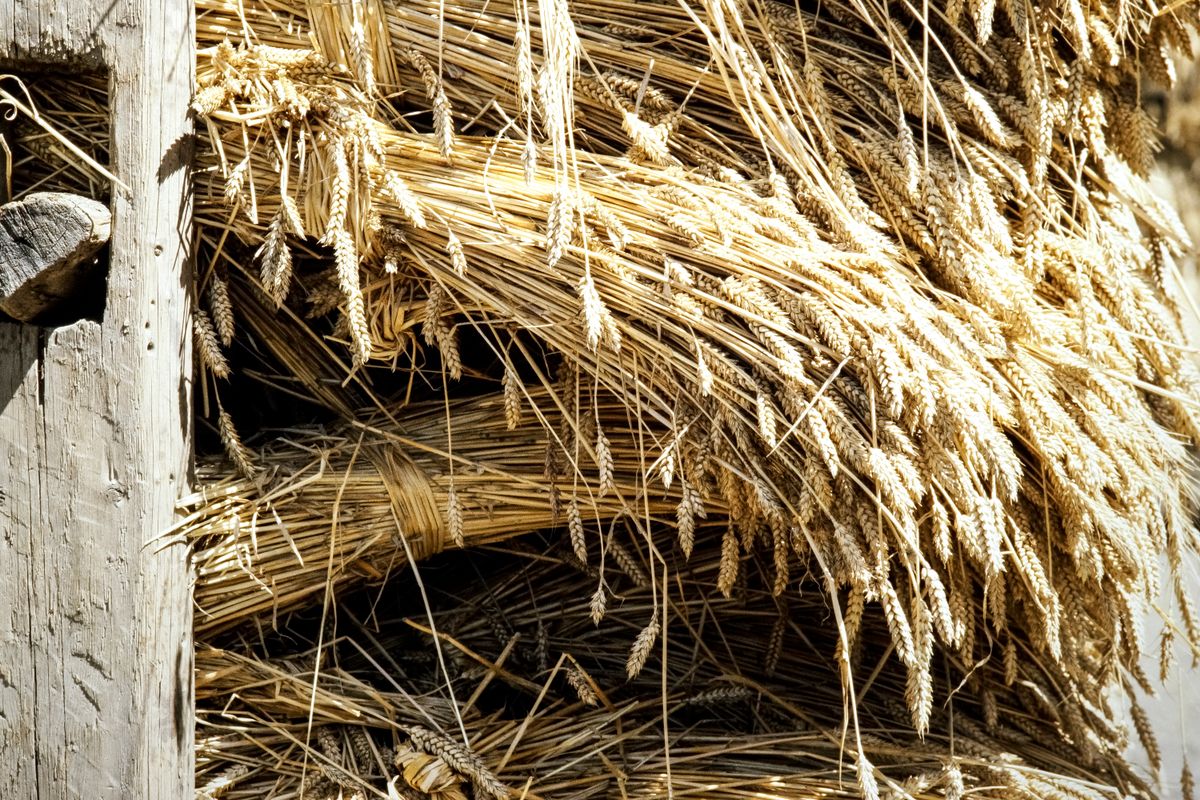
Sometime in the early 1990s a grain farmer near Parma, Claudio Grossi, cleared out his attic and found a sack of seed nobody could name. He tipped it onto a manure pile and forgot about it. What came up was miracle wheat: a six-foot heritage wheat whose stalks ended in a cluster of ears instead of one, in kernels of several colors. Grossi called it grano del miracolo, and the story of how it went from a forgotten sack to a protected Italian variety, told in the November 2026 issue of Smithsonian magazine, is one of the best ancient-grain stories we have read in years.
Quick answer: Miracle wheat (grano del miracolo) is an heirloom branched-ear form of Triticum turgidum, the wheat species that also includes durum, emmer, and khorasan. A farmer near Parma revived it from a forgotten sack of seed in the early 1990s, and it is now a registered local variety of Emilia-Romagna. It is a true wheat and contains gluten.
What is miracle wheat?
Miracle wheat is a tetraploid wheat whose ear branches: instead of one spike at the top of the stalk, it grows a main spike with several shorter side spikes bunched around it. Grossi’s plants carried seven ears per stalk, one long and six short, on stems roughly twice the height of modern wheat. Botanically it is Triticum turgidum. The University of Parma work that identified it called it poulard wheat (older English books say rivet wheat), and Emilia-Romagna’s official variety sheet files it under the durum subspecies. Either way it sits in the same family branch as emmer, khorasan, and the durum used for pasta, with four sets of chromosomes rather than einkorn’s two or bread wheat’s six.
| Wheat | Species | Chromosomes | Ear |
|---|---|---|---|
| Einkorn | T. monococcum | 14 | Single, slender |
| Wild emmer | T. turgidum subsp. dicoccoides | 28 | Single, shatters when ripe |
| Emmer | T. turgidum subsp. dicoccum | 28 | Single, hulled |
| Khorasan | T. turgidum subsp. turanicum | 28 | Single, long kernels |
| Durum | T. turgidum subsp. durum | 28 | Single, free-threshing |
| Miracle wheat | T. turgidum (branched form) | 28 | Branched, several ears per stalk |
| Spelt and bread wheat | T. aestivum | 42 | Single |
If the chromosome counts are new to you, our guide to wheat chromosomes explains why the jump from 14 to 28 to 42 changed how wheat bakes.
How did a sack of attic seed become a registered variety?
It took years of baking trials, one university thesis, and a regional seed law. Grossi’s first loaf barely rose, though it smelled nutty and tasted sweeter than bread from commercial flour. Working with an old-school local baker in the early 2000s, he found the dough held its shape when they made smaller batches, proofed them in tall wicker baskets, and kneaded far less. That last trick matches what bakers see with other tetraploid wheats: khorasan flour also has plenty of protein but slack, less elastic gluten, and it rewards a gentle hand.
A food science student who tasted the bread at a Parma farmers market, Beniamino Perobelli, made it the subject of his thesis and pinned down the species. A local organic mill, Molino Grassi, began grinding it for artisan bakers. Today grano del miracolo is entry RER V0108 in Emilia-Romagna’s register of local varieties, set up under regional law 1/2008 to protect heritage crops. The Stuard experimental farm near Parma conserves the seed, and Grossi’s own farm at Lesignano de’ Bagni is the designated seed multiplier.
One detail deserves a raised eyebrow: nobody knows how old the seed in that sack really was. Ordinary wheat seed stored at room temperature usually loses most of its ability to sprout within a decade or so, which is why seed banks keep grain frozen. The Smithsonian piece credits an earlier generation of the family with saving the heritage grain after most Italian farmers moved to modern varieties, so the seed in the sack was probably much younger than the farm itself.
Is miracle wheat the seven-eared grain from the Bible?
Probably not in any literal sense, though the connection is centuries old. In Genesis 41, Pharaoh dreams of seven full ears of grain growing on a single stalk, and Grossi, reading that passage at church, linked it to the strange plant in his manure pile. He was not the first to make that leap. Branched wheat has long carried Egyptian-themed names in Europe, such as the French blé d’Osiris, and in Victorian Britain a craze for “mummy wheat” claimed that grain taken from Egyptian tombs could still sprout. It could not, and historians have traced how that myth spread (History Today). The “King Tut’s wheat” origin story attached to Kamut belongs to the same romantic, unproven genre. Grossi’s grain is genuinely old as a type. Its route from ancient Egypt to a Parma attic is unknowable.
Why do branched ears interest wheat breeders?
More ears per stalk looks like a shortcut to more grain, so plant geneticists have studied branched wheat closely. A 2015 study in Genetics traced the branching to a single amino-acid change in a gene called branched head, the wheat counterpart of a gene that controls the same trait in barley (Poursarebani et al. 2015). Branched ears do carry more spikelets, but later work has found that each spikelet tends to set fewer grains, and the kernels can be lighter. That trade-off, plus the height problem below, is a big part of why the trait stayed a curiosity rather than becoming the norm.
Is miracle wheat healthier than modern wheat?
It may be more nutritious in some respects, but the evidence is thin. The figures reported so far come from one undergraduate thesis, which found more phosphorus and iron than in modern wheat, more of the amino acids lysine, tryptophan, and arginine, and less gluten than modern wheat. Those are interesting results that nobody has yet replicated in a peer-reviewed study. “Less gluten” also does not mean gluten-free: miracle wheat is a true wheat and is not safe for anyone with celiac disease. Like other tetraploid wheats it lacks bread wheat’s D genome, which carries one of the most reactive gluten fragments, a point we cover in our piece on ancient wheats and gluten sensitivity.
Why did miracle wheat disappear?
Height and yield pushed it out. Tall stems topple in wind, heavy rain, and hail before the grain ripens, and a crop that falls over is a crop you lose. Italy’s 1920s Battle for Grain campaign favored high-yield varieties, and the Green Revolution’s short-strawed wheats finished the job after the 1950s. Those modern wheats feed far more people per acre, but they lean on fertilizer and herbicide, partly because short plants cannot shade out weeds.
The same height is now part of the argument for bringing old wheats back. Grossi says his miracle wheat outgrows the weeds, copes with drought, and needs no fertilizer, and he solves the lodging problem by sowing it alongside shorter wheat that props it up. Francesco Sottile, an agrobiodiversity researcher at the University of Palermo, told Smithsonian that during Sicily’s severe 2024 drought, many commercial wheat growers gave up on their fields while farmers growing heritage grains still brought in a harvest. Planting more kinds of wheat spreads the risk when one kind fails.
Can you buy miracle wheat flour?
Rarely, outside Italy. Molino Grassi mills it, and imported bags occasionally reach specialty shops, but it is not a supermarket flour. The practical way to bake with its relatives is to use the tetraploid wheats that are easy to find. Kamut khorasan flour is a good stand-in for a sweet, buttery loaf that wants gentle kneading. Emmer flour brings the nutty depth of Italy’s original farro, and whole farro berries are the easy entry point if you would rather cook the grain than bake with it. Our ancient grain bread guide covers how each of these behaves in a loaf.
Where to go from here
Start with the two everyday cousins: the khorasan and emmer grain pages cover where each was first grown, nutrition, and the brands worth buying. For the deeper backstory, what is emmer wheat traces the founder crop that every tetraploid wheat, miracle wheat included, grew out of.
Frequently asked questions
Is miracle wheat gluten-free?
No. Miracle wheat is a form of Triticum turgidum, the same species as durum and emmer, so it contains gluten and is not safe for people with celiac disease.
Is miracle wheat the same as Kamut?
No. Kamut is the trademarked name for khorasan wheat, a different subspecies of the same species, with a single ear and long, narrow kernels rather than a branched ear.
Does miracle wheat always grow seven ears?
Not necessarily. Grossi’s plants showed a long central ear with six short side ears, but how much a branched wheat branches depends on its genes and growing conditions.
Bake with miracle wheat's cousins
Khorasan and emmer are the tetraploid heritage wheats you can actually buy, as flour or whole berries.
Shop khorasan →