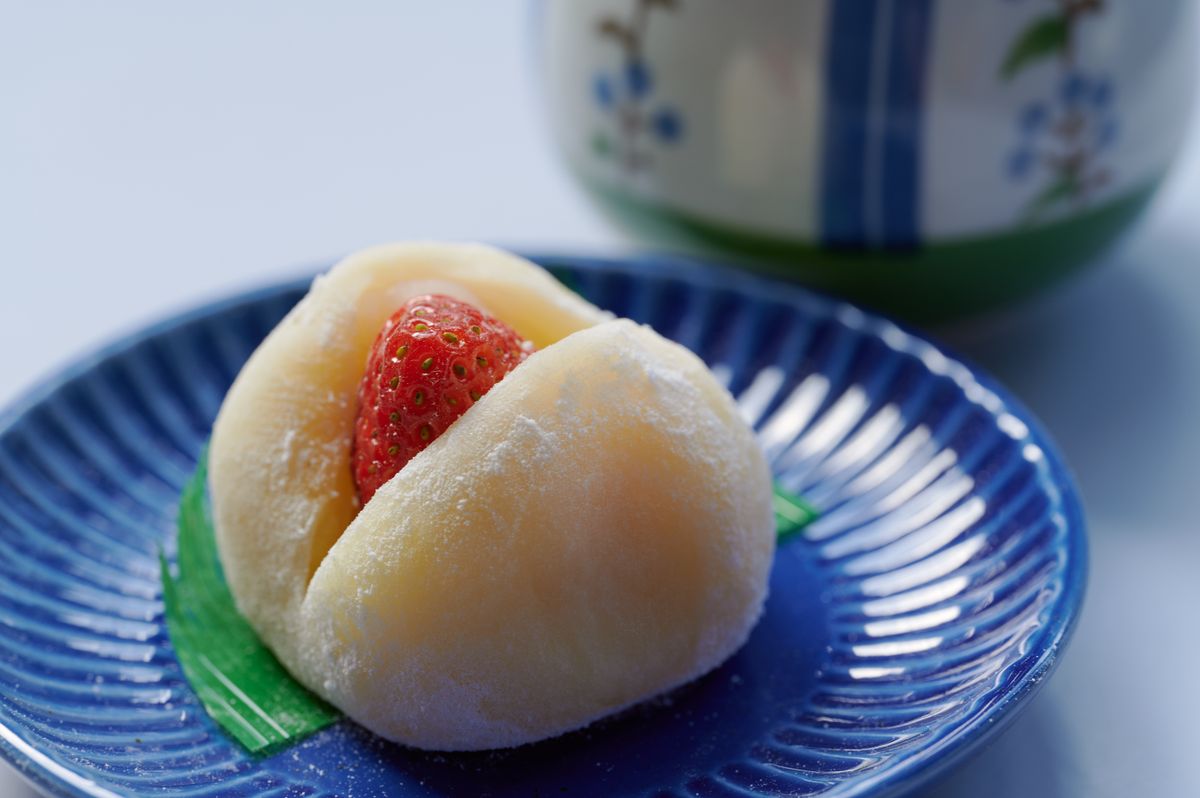
The first time I made mochi was in a tiny Beijing apartment kitchen with no steamer, and I learned fast that the microwave does the job better than tradition would have you believe. This mochi recipe turns three pantry ingredients into soft, cloud-chewy daifuku in about half an hour, no special equipment, no wrestling with a steamer basket. Wrap the mochi around sweet red bean paste or a whole strawberry and you have the exact confection sold for a few dollars a piece at Japanese sweet shops. It is also naturally gluten-free, because mochi is built entirely on rice.
Quick answer: To make mochi, whisk 1 cup glutinous rice flour with sugar and water, microwave in short bursts until the batter turns translucent and stretchy (about 4 minutes), then dust with starch, portion, and wrap each piece around a filling like red bean paste or a strawberry. It uses glutinous (sweet) rice flour, not regular flour, so it is naturally gluten-free.
How do you make mochi at home?
The microwave method is the one I recommend to everyone. It is faster than steaming, easier to control, and gives the same soft, elastic chew. Here is the full recipe for strawberry daifuku, the filled mochi that is the most popular version to make at home.
- 100 g (1 cup) glutinous rice flour (mochiko or sweet rice flour)
- 50 g (1/4 cup) granulated sugar
- 180 ml (3/4 cup) water
- 60 g (1/2 cup) potato starch or cornstarch, for dusting
- 200 g (about 3/4 cup) sweet red bean paste (anko)
- 10 small strawberries, hulled (optional, for strawberry daifuku)
- Mix. Whisk the glutinous rice flour and sugar together in a large microwave-safe bowl. Pour in the water and whisk until completely smooth, with no lumps. The batter will be thin.
- Microwave, about 4 minutes. Cover the bowl loosely with a microwave-safe lid. Microwave on high 1 minute, stir with a wet spatula, microwave 1 minute, stir again, then continue in 30-second bursts until the mochi is translucent, glossy, and very stretchy.
- Turn out and cool, 5 minutes. Dust a work surface and your hands generously with potato starch. Scrape the hot mochi onto it, dust the top, and let it rest until just cool enough to handle but still warm and pliable.
- Prep the filling. If making strawberry daifuku, wrap each hulled strawberry in a thin layer of red bean paste. Otherwise roll the paste into 10 balls.
- Shape. Divide the mochi into 10 pieces. Flatten each into a disc in your palm, set a filling in the center, and pinch the edges up and together to seal. Set each one seam-side down.
- Finish. Brush off the excess starch. Serve the same day for the softest texture.
Do you need special rice flour for mochi?
Yes, and this is the one thing people get wrong. Mochi needs glutinous rice flour, also sold as sweet rice flour, mochiko, or malagkit. It is milled from short-grain sticky rice and is nearly pure amylopectin, the starch that gives mochi its signature stretch. Regular rice flour will not work; it cooks up dry and crumbly instead of chewy. A bag of Koda Farms Mochiko is the classic choice and lasts a long time. If you want the full breakdown of the three rice flours and why only the sweet one works here, our rice flour guide covers it.
Despite the name, glutinous rice flour contains no gluten at all. “Glutinous” describes the glue-like stickiness of the cooked rice, not the protein.
What is the difference between mochi, daifuku, and butter mochi?
They are related but distinct, and the names get muddled constantly.
| Name | What it is | Method |
|---|---|---|
| Mochi | The chewy rice cake itself, plain or filled | Steamed or microwaved glutinous rice flour |
| Daifuku | Mochi wrapped around a sweet filling (anko, fruit) | The recipe above |
| Mochi ice cream | A thin mochi shell around a ball of ice cream | Mochi wrapped, then frozen |
| Butter mochi | A dense, cake-like Hawaiian baked bar | Baked with butter, eggs, and coconut milk |
Butter mochi is the outlier: it is baked, not steamed, and behaves like a chewy cake rather than a soft wrapper. It uses the same glutinous rice flour, so if you have a bag you can make either.
Is mochi gluten-free?
Yes. Mochi is made entirely from glutinous rice flour, and all rice is naturally gluten-free per the Celiac Disease Foundation, so traditional mochi and daifuku are safe on a gluten-free diet. Our is rice gluten-free explainer covers the full picture, including the rare exceptions. The only thing to watch is the filling: plain red bean paste and fruit are fine, but some flavored or commercial fillings and coatings can introduce wheat, so check the label on anything pre-made.
Why is my mochi hard or tough?
Two reasons, and both are easy to avoid. First, overcooking: mochi turns rubbery if microwaved too long, so stop the moment it is translucent and stretchy, not a burst later. Second, time: mochi is softest the day it is made and firms up in the fridge as the starch retrogrades, the same staling process that hardens bread. Keep it at room temperature under a dusting of starch and eat it within a day. If it does firm up, a few seconds in the microwave brings the chew back.
Where to go from here
Mochi is the gateway to a whole world of glutinous-rice sweets, from Filipino bibingka to Chinese tangyuan, all built on the same flour. Our rice flour guide is the next read if you want to understand the ingredient, and the gluten-free grains guide maps the broader pantry of naturally gluten-free options like sorghum and quinoa if you bake without wheat. Mochi rewards a light hand and same-day eating; nail those two things and the rest is just choosing your filling.
Frequently asked questions
Can you make mochi without a microwave?
Yes. Steam the same batter in a heatproof bowl over simmering water for about 15 to 20 minutes, stirring once or twice, until it is translucent and stretchy. The microwave is faster, but steaming is the traditional method and works just as well.
How long does homemade mochi last?
Mochi is best the day it is made. It firms up within a day as the rice starch sets, so store it at room temperature under a dusting of starch rather than in the fridge, which hardens it faster. Filled daifuku with fresh fruit should be eaten the same day.
What can you use instead of red bean paste?
Plenty. A whole strawberry, sweetened peanut or sesame paste, Nutella, custard, or a small square of chocolate all work as fillings. For strawberry daifuku, wrapping the berry in a little bean paste first keeps it from weeping into the mochi.
Is glutinous rice flour the same as regular rice flour?
No. Glutinous (sweet) rice flour is milled from sticky short-grain rice and is what makes mochi chewy; regular rice flour comes from standard rice and bakes up dry. They are not interchangeable in this recipe, though neither contains gluten.
Get the right flour for mochi
Glutinous rice flour is the one ingredient you cannot substitute. Koda Farms Mochiko is the classic, and a bag lasts for many batches.
Shop mochiko →Build your gluten-free pantry
Rice is just the start. Browse the naturally gluten-free grains and flours we trust, from sorghum to buckwheat to teff.
Browse all grains →