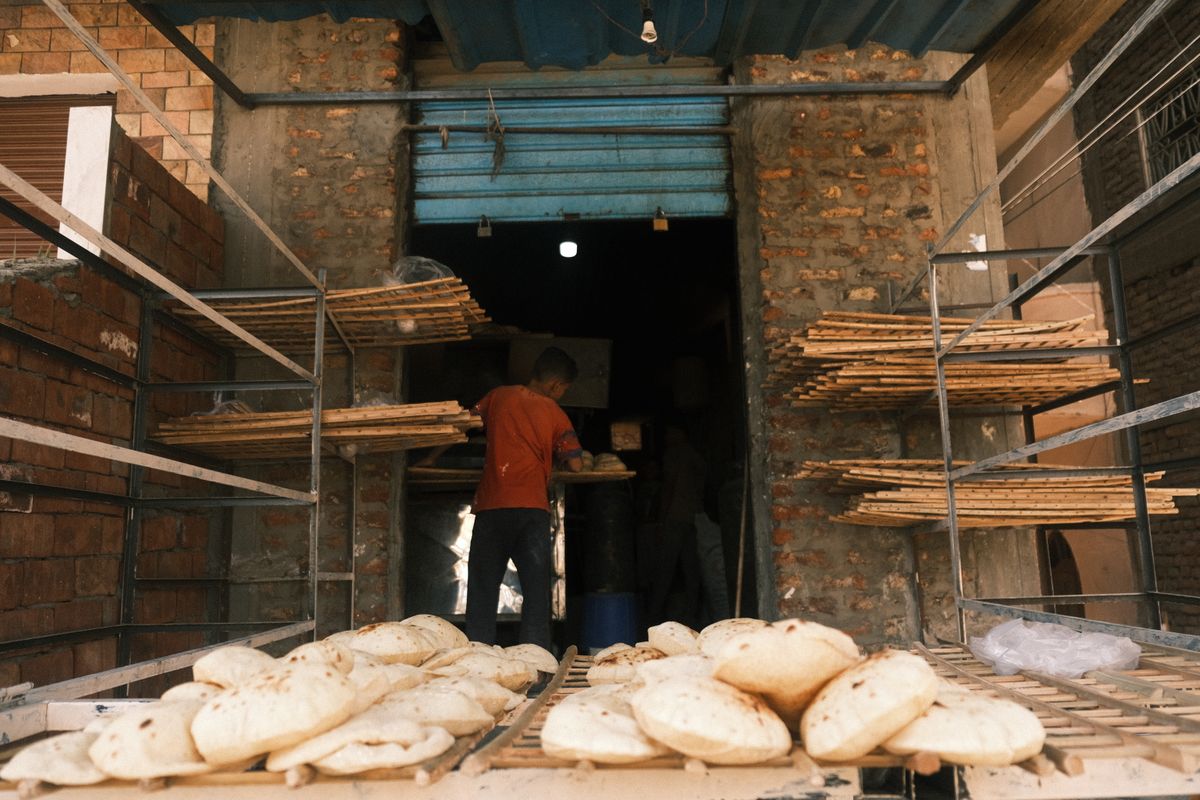
What did ancient Egyptians eat? For most people, most days, the answer was bread and beer, and both were made from the same two grains: emmer wheat and barley. A 2026 entry on cereals in the UCLA Encyclopedia of Egyptology calls them the two staple foods of ancient Egypt, and says the lives of most of the population revolved around growing and processing them. Surviving loaves, tomb paintings and grain left in burials let us trace that diet in unusual detail, and emmer is still easy to buy and cook today.
Quick answer: Ancient Egyptians lived mainly on bread and beer made from emmer wheat and barley, the two staple cereals of the country. Cereals were grown in Egypt from at least 4,500 BCE, and emmer stayed the main wheat until durum wheat replaced it around 200 BCE. Vegetables such as lettuce, fruit such as figs and dates, and occasional meat added to a diet built on grain.
What did ancient Egyptians eat every day?
Ancient Egyptians ate bread and drank beer every day, both made from emmer wheat and barley. National Museums Liverpool, which holds loaves and grain from New Kingdom tombs, describes the staples of the Egyptian diet as bread and beer, and the 2026 UCLA Encyclopedia of Egyptology entry on cereals by archaeobotanist Claire Malleson says every fertile region of Egypt would have been covered each year with crops of those two cereals.
The rest of the diet came from gardens, orchards and animals. Old Kingdom tomb scenes show workers carrying pots of water to tip onto plots of lettuce, and New Kingdom paintings show a water-lifting shaduf used in a garden with a pomegranate tree. Some surviving loaves contain figs and dates worked into the dough. Meat was a luxury: a 4,000-year-old tomb model at Liverpool shows a kitchen producing bread, beer and, as the museum puts it, a little beef for the tomb owner’s afterlife.
When did Egyptians start growing emmer wheat?
Egyptians were growing cereals by at least 4,500 BCE. The Malleson entry names five sites with good evidence for the earliest domestic cereals: the north shore of the Fayum, Merimde Beni Salama, el-Omari, Kharga Oasis and Sais. Radiocarbon dating puts the earliest Fayum samples at about 5,000 BCE, give or take 500 years, and the oldest Merimde samples at about 4,800 BCE. Both barley and emmer turn up at all of them.
Emmer did not start in Egypt. It was domesticated in western Asia and arrived as part of a package of crops and animals (sheep, goat, cattle, pig, emmer and hulled barley), and DNA work has linked ancient Egyptian emmer to wheats from the southern Levant. By the early Predynastic period, about 4,000 to 3,400 BCE, emmer and barley were being grown at sites such as Naqada and Hierakonpolis, a sign the new crops spread quickly along the Nile. For the deeper story of the grain itself, see what emmer wheat is.
Why did Egyptians grow emmer instead of easier wheats?
Emmer is a hulled wheat: each grain is locked in tough chaff that takes extra work to remove. Free-threshing wheats like durum and bread wheat were already known in western Asia, yet Egyptians kept growing emmer for thousands of years. Malleson suggests the most likely reason is pest resistance, with the chaff acting like a coat of armor around the grain in storage.
The switch came late. Durum wheat became the staple around 200 BCE, in the middle of the Ptolemaic period, and bread wheat only became Egypt’s main wheat crop in the 1970s.
| Period | Approximate date | Main wheat |
|---|---|---|
| Neolithic to Ptolemaic | 4,500 to 200 BCE | Emmer |
| Ptolemaic to 20th century | 200 BCE to 1970s | Durum |
| Modern Egypt | 1970s onward | Bread wheat |
Barley ran alongside all three as the other staple. Einkorn, the other ancient hulled wheat, appears in Egyptian finds only as an occasional weed in other crops, never as a staple. Our emmer vs einkorn comparison explains how the two differ in the kitchen.
How did Egyptians make bread from emmer?
They pounded, dried, winnowed and sieved the grain before grinding it into flour on stone querns. Delwen Samuel, who studied about 20 surviving Egyptian loaves for her Cambridge PhD, reconstructed the steps, as a UCL researchers’ account of her work summarizes. Emmer spikelets were moistened and pounded with wooden pestles in limestone mortars, dried in the sun, winnowed to blow off the fine chaff, and sieved to remove the heavier pieces. Only then could the clean grain be ground on a saddle quern.
Baking changed over time. In the Old Kingdom, dough was baked in moulds set on the embers of a hearth. Later, bread was baked on the inner walls of pottery cylinders, and true bread ovens appear in the New Kingdom. Under the microscope, Samuel found that loaves were mainly emmer flour, some with barley flour, figs or dates added, and some with visible yeast cells.
Loaves came in many shapes. The Met holds a conical loaf of bread about 15 cm long, buried in a foundation deposit at Hatshepsut’s temple at Deir el-Bahri around 1473 to 1458 BCE. Liverpool’s collection includes flat loaves and long conical ones. If you want to see how Egyptian bread compares with even older finds, our list of the oldest bread in the world goes back 14,400 years.
Did ancient Egyptian bread damage their teeth?
Yes. Ancient flour was far less refined than modern flour, and National Museums Liverpool notes in its record of a barley bread offering that even the finest sieves could not remove sand and dirt. That grit wore teeth down, and the museum says many ancient Egyptians suffered from toothache, abscesses and tooth loss as a result.
What was ancient Egyptian beer made from?
Egyptian beer was made from the same emmer wheat and barley as bread, and the two were often produced side by side. Samuel concluded that brewers may have used up to four different techniques, with both malted (sprouted) and unmalted grain. Scribal training texts, including the Rhind Mathematical Papyrus, set problems about converting quantities of grain into loaves and into beer of a given strength. The best physical evidence, a 5,600-year-old brewery at Hierakonpolis, is covered in our guide to the oldest beer in the world.
Why did Egyptians bury grain and bread in tombs?
Grain and bread in a tomb were meant to feed the dead forever. The Malleson entry describes baskets of grain and small models of farming, baking and brewing placed in tombs to guarantee an eternal supply of cereals in the afterlife. Liverpool’s emmer wheat grain, dated to the New Kingdom (about 1550 to 1069 BCE), was probably taken from the tombs at Thebes for exactly this reason.
The best-known example is Tutankhamun’s tomb, where Howard Carter found 128 baskets, jars and granary models holding seeds, grains and fruit. When the samples were finally studied in the late 1980s, 51% of the identified non-cereal items turned out to be field weeds, so even a king’s grain came from ordinary weedy fields. Wooden granary models were a regular part of these burials from the late Old Kingdom on, and mouse droppings found in several of them suggest why so few still hold grain. Our post on how ancient farmers stored grain covers the real granaries behind those models.
Grain also carried religious meaning. Because cereals were tied to the god Osiris and ideas of rebirth, some New Kingdom tombs held Osiris beds: Osiris-shaped boxes filled with soil and grain. Seven are known from six high-status tombs at Thebes, including those of Tutankhamun and Horemheb, and the grain in them had sprouted.
How to eat like an ancient Egyptian today
Emmer is the easiest part of the ancient Egyptian diet to recreate, because it is sold today as farro. A bag of whole-grain farro cooks like a chewy, nutty rice; our guide on how to cook farro covers the timing. For bread, stone-ground emmer flour bakes a dense, flavorful loaf, closer to Egyptian bread than anything made from modern white flour, and without the sand. Pair it with barley, the other half of Egypt’s grain supply.
Frequently asked questions
Did ancient Egyptians eat meat?
Yes, but not often. National Museums Liverpool describes the beef in a 4,000-year-old tomb model kitchen as a little bit of luxury beside the everyday bread and beer.
Is farro the same as Egyptian emmer?
Partly. Farro is an Italian name for three ancient hulled wheats (einkorn, emmer and spelt), and farro medio is emmer, the same species ancient Egyptians grew. A bag labeled “farro (emmer)” is the one to buy.
Did ancient Egyptians use yeast in bread?
Yes. Microscope studies of surviving New Kingdom loaves found yeast cells in some of them, though exactly how the Egyptians leavened their dough is still not settled.
When did Egyptians stop growing emmer?
Emmer stopped being Egypt’s staple wheat around 200 BCE, during the Ptolemaic period, when durum wheat replaced it.
Cook the wheat of the pharaohs
Emmer is still grown and sold today as farro and as stone-ground flour. See our picks for whole emmer and emmer flour.
Shop emmer →