How did ancient farmers store grain? The question matters more than it sounds, because a harvest comes once a year and people eat every day. Whoever could keep grain dry, cool and away from mice through the winter had food in spring and seed for the next sowing. The archaeology of storage is thinner than the archaeology of bread, but a handful of finds, including a dig in North Macedonia that made headlines in 2026, show the main solutions: raised granaries, pits in the ground, clay bins inside the house, and sacks on a shelf.
Quick answer: Ancient farmers stored grain in raised granaries, underground pits, clay bins built inside houses, and sacks or jars kept indoors. The oldest known purpose-built granaries, at Dhra' in Jordan, are about 11,300 years old and had suspended floors for air circulation and protection from rodents. In northern China, millet was kept in storage pits at Cishan between about 10,300 and 8,700 years ago.
How did ancient farmers store grain?
Ancient farmers stored grain in four main ways: in freestanding granaries with raised floors, in pits dug into the ground, in clay bins and installations built inside houses, and in sacks, bags or jars kept on shelves indoors. Each method answers the same three threats, which are damp, warmth and animals. The examples below are the ones with solid published evidence, and they span about 6,000 years and three regions.
What are the oldest known granaries?
The oldest known purpose-built granaries were found at Dhra’, near the Dead Sea in Jordan, and date to roughly 11,300 to 11,175 years ago. Ian Kuijt and Bill Finlayson described them in PNAS in 2009, and two details stand out.
The first is the design. The granaries had suspended floors, which let air move under the stored food and kept it out of reach of rodents. They stood between houses that contained plant-processing installations, so storage and preparation sat side by side.
The second is the date. The people of Dhra’ were not yet farming domesticated crops. They were cultivating wild cereals, and the authors put these granaries at least 1,000 years before domestication and before large settled villages. In other words, storage did not follow farming. It came first, and it may be one of the things that made farming possible.
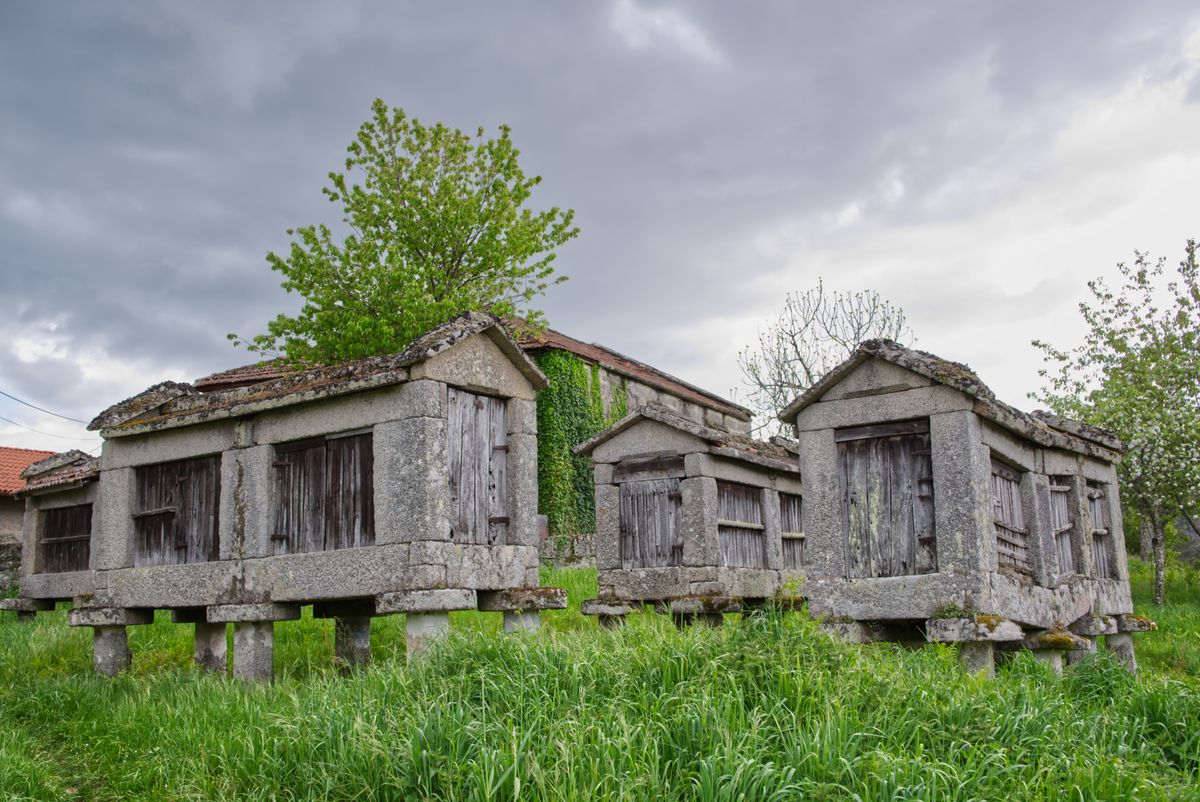
The raised floor never went out of use. The stone granaries in the photo at the top of this page, in rural Portugal, stand on pillars for the same reasons.
Where did the first millet farmers keep their grain?
In pits. At Cishan, in Hebei province in northern China, researchers examined newly excavated storage pits and found husk remains and chemical traces of broomcorn millet dated to between about 10,300 and 8,700 years ago. The oldest pits held broomcorn millet alone, and small amounts of foxtail millet appear only after about 8,700 years ago (PNAS, 2009).
Those pits are the reason Cishan matters so much to the story of the first millet farmers. Without stored grain there would be very little millet left to study. The same grain is still grown today as common millet.
What are the “Guardians of Grain” from North Macedonia?
They are ceramic cult objects found in 2026 inside a Neolithic building at Atici-Spomenik, a settlement about 8,000 years old near Lake Dojran in North Macedonia. The nickname comes from news coverage, not from the excavators, and it rests on an interpretation that has not been published in a journal yet.
Here is what the sources say. The Macedonian outlet UMNO reported the find on 17 June 2026: rare Neolithic cult objects with incised symbols and an animal head, from a dig run by the Archaeological Museum in Skopje under Elena Stojanova-Kanzurova. She describes Atici-Spomenik as the only Neolithic site known so far in the Dojran basin. It was first excavated in 1988, and a geomagnetic survey in 2024 showed the settlement spread along both sides of a stream. The stated goal of the new season was to define the plan of one house and its fixed interior fittings.
The storage angle arrived in September, when Arkeonews reported two objects, one covered in wavy and triangular motifs and one shaped like a small animal on legs, possibly a goat. Citing information from the museum, it said the building also held rectangular and circular clay installations that were probably used for storing and processing food, especially cereals. That is the basis for the idea that the objects watched over the grain.
It is a reasonable reading, and it is still a reading. The same article says plainly that the exact purpose of the objects remains unknown. What the find does show is that 8,000 years ago in the Balkans, the place where a household kept its cereals was important enough to share a room with its ritual objects.
Ancient grain storage at a glance
| Site | Age | How grain was kept |
|---|---|---|
| Dhra’, Jordan | About 11,300 years | Raised-floor granaries |
| Cishan, China | 10,300 to 8,700 years | Storage pits |
| Atici-Spomenik, North Macedonia | About 8,000 years | Clay installations (probable) |
| Seyitömer, Türkiye | About 5,000 years | Sacks on a shelf |
The last row is covered in detail in our piece on the oldest bread in the world. At Seyitömer, bread, wheat and lentils were probably kept in sacks or bags on a shelf near an oven, and a fire that brought the shelf down is what preserved them. By Roman times stored grain supplied whole commercial bakeries, like the ones behind Pompeii bread.
What spoils stored grain?
Moisture, warmth, insects and rodents spoil stored grain, and moisture is the worst of them. Utah State University Extension, which publishes detailed guidance on storing wheat, puts numbers on it. Above about 12% moisture, grain starts to respire and degrade. Above 15%, molds can grow. Warmth speeds up the decline, and rodents can chew through plastic bags.
Set that list beside the Dhra’ granaries and the logic of a suspended floor is obvious. Air circulation deals with damp, and height deals with rodents. Early builders had no moisture meters, but they were solving the same problem a modern pantry has.
How should you store whole grains at home?
Store whole grains dry, cool, sealed and off the floor. The Utah State guidance recommends moisture-proof, food-grade containers, a storage temperature of 40 to 60°F where possible, and keeping containers off concrete, which wicks moisture. It also suggests packing wheat in bags of about 10 pounds, so a problem in one bag does not spread to the whole supply.
Whole kernels are the form to store. An intact berry protects its own oils, which is why einkorn berries or a bag of hard red wheat berries will outlast any bag of whole-grain flour. Our guide to hard white wheat berries covers buying in bulk, and the home grain mill guide covers turning stored berries into flour when you need it.
One piece of folk wisdom does not survive the science. The same extension page lists bay leaves, nails and salt as having no effect at all on insects or their eggs. Freezing bags of grain for two to three days is its recommended treatment for live pests.
Where to go from here
The grains in these early stores are still on the shelf. Einkorn, emmer and barley were among the first crops farmed in the Near East, and all three keep well as whole kernels.
Frequently asked questions
Did people store grain before they farmed it?
Yes. The granaries at Dhra’ in Jordan are about 11,300 years old and belonged to people who cultivated wild cereals, at least 1,000 years before domesticated crops appeared.
How long do wheat berries last in storage?
Utah State University Extension suggests rotating stored wheat so that none is older than 5 years. It also cites a Brigham Young University study in which wheat sealed in No. 10 cans still made acceptable bread after 32 years.
Do bay leaves keep bugs out of stored grain?
No. Utah State University Extension lists bay leaves, nails and salt as having no effect on insects or insect eggs in stored wheat.
Does grain need to be stored without oxygen?
Not usually. According to Utah State University Extension, wheat does not need oxygen-free storage unless insects are present.
Stock your own granary
Einkorn is the oldest wheat you can buy. See our picks for whole berries and flour, and store the berries the way farmers always have: dry, cool and sealed.
Shop einkorn →