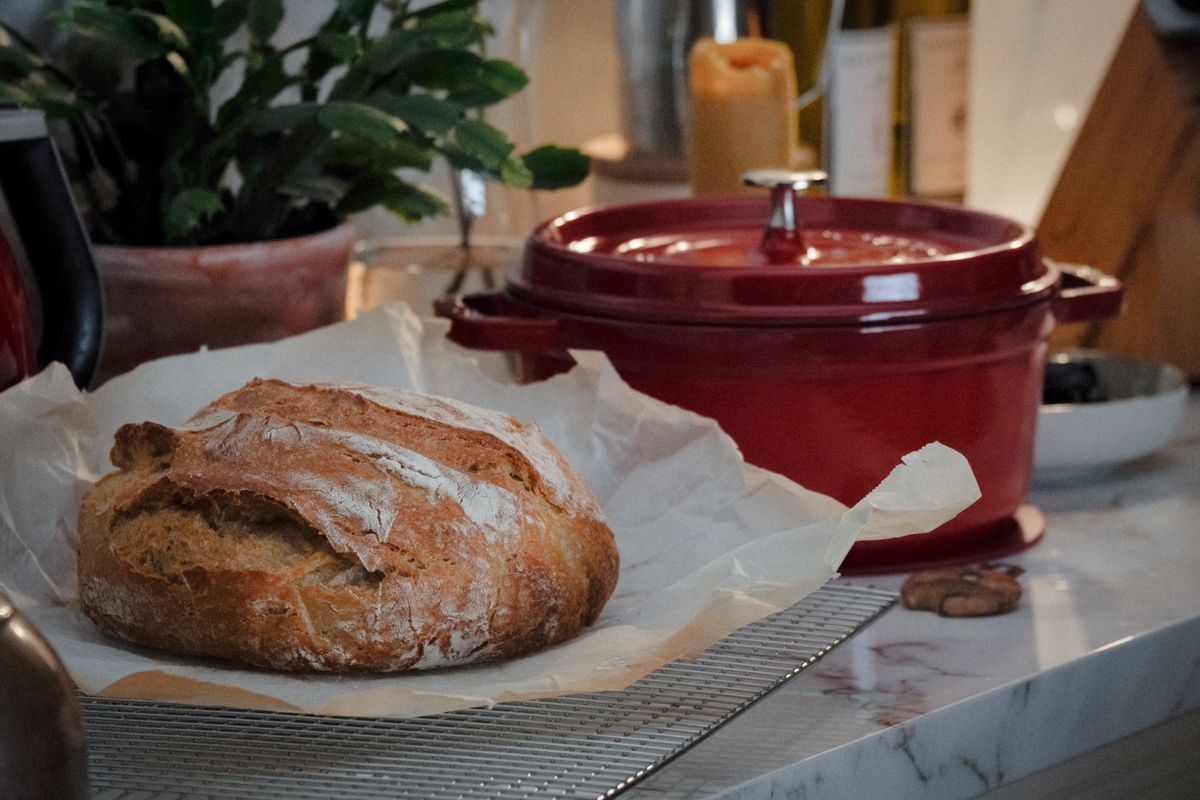
Choosing a Dutch oven for sourdough bread is mostly a question about steam, and only secondarily about the pot. A home oven cannot inject steam the way a bakery deck oven does, so the trick every no-knead recipe relies on is trapping the loaf’s own moisture in a sealed cast-iron chamber for the first twenty minutes, which is the same principle behind the steam techniques King Arthur Baking documents for home ovens. Almost any heavy lidded pot does that. What separates a good one from a frustrating one is how easily you can get a wet, sticky, proofed loaf into it without burning your knuckles.
Quick answer: Any heavy cast-iron pot with a tight lid will bake excellent sourdough, so buy on size and loading ease rather than brand. A 5 to 7 quart round pot suits nearly every home loaf. Enamelled is the low-maintenance default; bare cast iron is cheaper and tougher but needs seasoning. If you find lowering dough into a deep pot awkward, a combo cooker (a shallow skillet base with a deep lid) is genuinely easier and usually cheaper.
What actually matters in a Dutch oven for bread?
Four things, in this order: it must hold a lid tightly, it must be cast iron or similarly heavy, it must be oven-safe to at least 450°F, and you must be able to load a loaf into it without a struggle. Everything else, colour, brand, handle shape, is preference.
The knob is the one specification worth checking before you buy. Many enamelled pots ship with a phenolic or plastic knob rated only to 400 or 425°F, and sourdough wants 450 to 500°F; Lodge and most makers publish the rating in their care documentation. Cast-iron or stainless knobs have no such limit, and on most pots the knob is a replaceable part if you get this wrong.
Which size Dutch oven should you buy?
Five to seven quarts covers essentially every home loaf, and 6 quart is the safest single answer. A 500 g flour loaf has room to spring in a 5 quart pot; a 1 kg loaf wants 7. Too large is a milder mistake than too small: in an oversized pot the steam disperses a little and the crust is marginally thinner, whereas in an undersized one the loaf touches the wall and scorches. Our what size Dutch oven for bread guide works through round versus oval and the arithmetic behind those numbers.
Enamelled or bare cast iron?
Enamelled for most people. The coating means no seasoning, no rust, and you can wash it normally, which matters when a sticky sourdough crust welds itself to the base. The trade-offs are real though: enamel chips if you knock it, it cannot go under a broiler indefinitely, and it costs more.
Bare cast iron is cheaper, effectively indestructible, and takes higher heat without complaint. It also needs seasoning, will rust if left wet, and a wet dough sticks to it more readily unless you bake on parchment. If you already own and maintain cast iron, there is no reason to buy enamelled; if you do not, enamel removes a whole category of things to get wrong.
The three picks
Prices move, so these are ranked by what each one solves rather than by cost. (For the full five-pot lineup, including a bare-iron Lodge and the Le Creuset, see our best Dutch ovens for bread picks.)
| Pot | Best for | Why it earns the spot |
|---|---|---|
| Lodge Essential Enamel, 6 qt | The default buy | Enamelled, 6 quart, from the most established cast-iron maker in the US. The size that fits nearly every recipe, with the least to think about. |
| Cast-iron combo cooker | Easiest loading, lowest price | A shallow skillet base with a deep lid. You bake on the flat pan and cover it, so you never lower dough into a deep pot. The cheapest way in. |
| Overmont enamelled, 7 qt | Bigger loaves | The extra quart matters if you bake 1 kg loaves or oval batards. Enamelled, and usually well under the price of the premium French brands. |
If you want the one-line version: buy the 6 quart enamel Dutch oven unless deep-pot loading worries you, in which case buy the combo cooker.
Why a combo cooker is underrated
This is the recommendation most buying guides skip, and it is the one I make most often to nervous first-timers. A standard Dutch oven asks you to lower a slack, proofed loaf into a 450°F cavity between two hot walls, usually by holding parchment corners and hoping. A combo cooker inverts the geometry: the shallow pan is the base, so you tip the loaf onto an open surface at counter height and then lower the deep half over it as a lid.
The bake is identical, because the sealed chamber is the same volume of trapped steam either way. What changes is the twenty seconds where most burns and most misshapen loaves happen. The trade-off is that a combo cooker is a worse pot for stew, so if you want one vessel for both jobs, take the round Dutch oven.
Do you need a Dutch oven at all?
No, and it is worth saying so plainly on a page recommending them. A heavy roasting tin with a metal bowl inverted over the loaf traps steam adequately. A baking stone with a tray of boiling water underneath works less well but works. Our Dutch oven bread recipe covers the workarounds, and sourdough focaccia needs nothing but a pan, which is why it is where I send people who do not want to buy anything yet.
What a Dutch oven buys you is consistency. The steam environment is repeatable, so the variable that most often ruins a home loaf simply stops varying.
Where to go from here
The pot is one of three things that change a sourdough loaf more than any recipe tweak: a proper steam chamber, a banneton to hold the shape during the final proof, and flour with enough character to taste. For the last of those, spelt and rye are the two heritage flours that reward the long ferment most, and the ancient grain bread guide maps how each behaves.
Frequently asked questions
Can you preheat an enamelled Dutch oven empty?
Yes, up to the manufacturer’s stated limit, which is usually 450 to 500°F. Heat it gradually with the oven rather than putting a cold pot into a hot one, and check the knob rating first.
Does the colour of the enamel matter?
Only for the interior. A light-coloured inside lets you see how far the crust has browned when you take the lid off; a dark interior hides it. Exterior colour is decoration.
Will a sourdough loaf stick to the pot?
Not if you bake on parchment, which is what almost everyone does. Directly on bare enamel a wet dough can grab, and semolina or rice flour on the base helps if you would rather skip the paper.
Is an expensive French Dutch oven worth it for bread?
For bread specifically, no. The enamel and casting quality on premium pots are genuinely better and they last generations, but the loaf cannot tell. Spend the difference on flour.
Get the pot that makes the crust
A 6-quart enamelled Dutch oven is the safest single buy for sourdough. If loading a deep pot worries you, take the combo cooker instead.
Shop Dutch ovens →Then feed it proper flour
See our hand-picked spelt, from whole-grain flour to berries, with the brands worth buying.
Shop spelt →