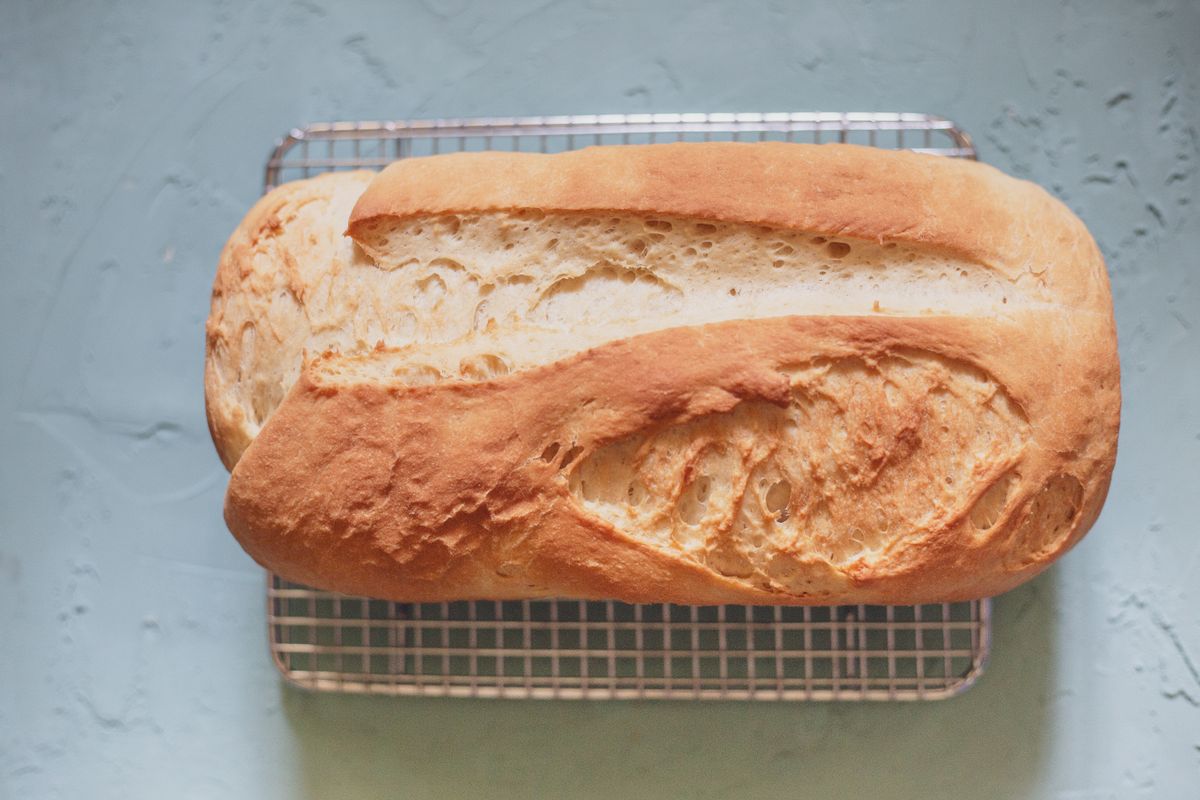
I bake most of my bread by hand, but there is a bread machine on my worktop all the same, and I am not the least bit embarrassed by it. The best bread machine recipes are not a compromise; they are the difference between fresh bread on a wet Tuesday and no bread at all. The machine kneads, proves, and bakes while you get on with your day, and once you understand the one master recipe hiding underneath nearly every loaf, you can bend it to whatever flour you fancy, including the heritage grains I spend my days with. Here is that master loaf, and the handful of small changes that turn it into whole wheat, spelt, einkorn, seeded, or pizza dough.
Quick answer: Most bread machine recipes are one master formula in disguise: liquid, fat, flour, a little sweetener, salt, and yeast, layered into the pan wet-first with the yeast kept dry on top. For a 2 lb loaf, that is about 1.5 cups water, 3 tablespoons fat, 4 cups bread flour, 2 tablespoons honey, 2 teaspoons salt, and 2.25 teaspoons bread machine yeast on the Basic course. Swap in whole wheat or heritage flour with a touch more or less water and the Whole Wheat course, or run the Dough cycle only to make pizza dough. It is wheat bread, so it contains gluten.
Why start with one master bread machine recipe?
Because almost every loaf a machine makes is the same six ingredients in the same order, and once that order is second nature the recipe book stops mattering. A bread machine kneads, proves, and bakes on a timer, so your only real jobs are getting the ratios roughly right and loading the pan correctly. What a machine trades away is the crust, since it cannot trap steam the way a Dutch oven loaf does. What it gives back is a soft, even sandwich loaf with zero fuss, which on most weekdays is exactly the trade I want.
The master bread machine loaf
This is the everyday loaf, the one every variation below is built from. It makes a soft-crumbed 2 lb sandwich loaf on the Basic course.
- 1 1/2 cups (360 ml) water, lukewarm (about 80°F / 27°C)
- 3 tbsp (45 ml) neutral oil or softened butter
- 2 tbsp (30 g) honey (or 3 tbsp sugar)
- 4 cups (500 g) bread flour
- 2 tsp (12 g) fine salt
- 2 1/4 tsp (7 g) bread machine or instant yeast
- Load the pan wet first. Pour the water, oil, and honey into the bread pan, then tip the flour on top so it covers the liquid completely. This keeps the yeast from waking too early.
- Keep the salt and yeast apart. Scatter the salt into one corner on top of the flour, then spoon the yeast into a small well in the centre. Salt kills yeast on contact, so the flour keeps them apart until the blade brings everything together.
- Choose the course. Fit the pan into the machine, close the lid, and select the Basic or White course, a 2 lb loaf, and a medium crust. Press start.
- Leave it well alone. The machine kneads, rests, proves, and bakes on its own over about three hours. Resist lifting the lid during the final rise and bake, since letting the heat out can collapse the loaf.
- Check it, then cool it. When the cycle ends the loaf is done at an internal 190 to 200°F. Tip it out of the pan and cool it on a rack for at least 30 minutes before slicing, because a warm loaf slices gummy every time.
Can you use whole wheat and heritage flour in a bread machine?
Yes, and this is where a machine truly earns its place in a baking kitchen, because it takes the fear out of the dense whole-grain doughs that put people off by hand. Whole wheat and heritage flours drink more water than white bread flour and carry weaker or different gluten, so each wants a small tweak to the master loaf. The table sorts out what to change.
| Loaf | Flour change | Water change | Course | Note |
|---|---|---|---|---|
| Honey whole wheat | Swap 2 cups for whole wheat | Add 2 tbsp water plus 1 tbsp vital wheat gluten | Whole Wheat | The gluten boost gives it lift |
| Spelt | Swap up to half for whole spelt | Cut 2 tbsp water | Whole Wheat | Sweet and nutty, a touch denser |
| Einkorn | Swap up to half for einkorn | Cut 3 tbsp water | Whole Wheat or custom | Weak gluten, so watch the dough ball |
| Seeded oat | Add 1/4 cup oats and 2 tbsp seeds | Leave as is | Basic | Add at the mix-in beep |
Whatever the flour, the habit that matters more than any recipe is checking the dough ball about ten minutes into the knead: it should form a smooth, slightly tacky ball that just clears the sides of the pan. Too wet and it slumps; too dry and it rides around in a stiff lump. Correct it with water or flour a teaspoon at a time, since heritage flours especially drink water unpredictably. Our einkorn bread and spelt bread guides lean on that feel rather than fixed numbers.
What yeast do you use in a bread machine?
Bread machine yeast, which is simply instant yeast milled a little finer so it disperses fast and needs no proofing; you add it dry, straight into the flour. Bread machine yeast and instant yeast are interchangeable, and even ordinary active dry yeast works one-for-one in a machine, because the long cycle hydrates it without the separate proofing step a hand recipe would need. What you should not use is fresh or cake yeast, which is formulated for a different rise. A 2 lb loaf wants about 2.25 teaspoons, which is one standard packet, or 7 grams. Keep the tub in the freezer once opened; yeast that has quietly died on a warm shelf is the single most common reason a machine loaf comes out short and heavy.
Can you make pizza dough in a bread machine?
Yes, and the Dough cycle is the most underused button on the machine; it kneads the dough and runs the first rise, then stops before baking so you shape and bake in your own oven. For pizza, use the master base but drop the water to 1 1/4 cups, swap the oil for 2 tablespoons of olive oil, and leave out most of the honey. Run the Dough cycle, which takes around ninety minutes, then turn the risen dough onto a floured counter, shape it, top it, and bake on a hot stone or tray at 475°F. The same cycle also makes dinner rolls, focaccia, and a rustic boule you finish in a Dutch oven for a proper crust.
Why did my bread machine loaf sink or turn out dense?
A sunken top usually means too much liquid or too much yeast, and a dense, short loaf usually means too little gluten or a yeast that never got going. Nearly every machine-loaf failure traces back to the dough ball or the yeast, and the table sorts the common ones.
| Problem | Likely cause | Fix |
|---|---|---|
| Collapsed or sunken top | Too much water, or too much yeast in warm weather | Cut the water 1 to 2 tbsp, and reduce yeast slightly in summer |
| Dense, short loaf | Weak-gluten or whole-grain flour, or dead yeast | Add vital wheat gluten, use the Whole Wheat course, and check the yeast is alive |
| Gummy crumb | Sliced while still warm | Cool the loaf a full 30 minutes |
| Pale, soft crust | The machine’s crust setting runs light | Select a dark crust, or finish 5 minutes in a hot oven |
| Doughy hole in the base | The kneading paddle baked in | Normal; fish the paddle out before slicing |
The ten-minute dough-ball check heads off most of these before the machine gets to the rise.
Where to go from here
A machine is the easy road to weekday bread; the flour is what makes it worth eating. Fresh whole grain bread flour and the heritage grains behind it, spelt, einkorn, and rye, all take to a machine with the small tweaks above, and if you would rather grind your own, our home grain mill picks pair beautifully with one. When you want the crackly crust a machine cannot give you, our Dutch oven bread guide is the natural next step. And if you are still choosing a machine, our five bread machine picks run from a budget starter to the Zojirushi that sits on my own worktop.
Frequently asked questions
Can you make gluten-free bread in a bread machine?
Yes, on a machine with a dedicated gluten-free course, which skips the punch-down and second rise that wheat cycles use. Pair it with a proper gluten-free bread flour blend and a binder like psyllium; a standard Basic course will not rise a gluten-free batter properly.
Is bread machine bread as good as oven-baked bread?
For soft sandwich loaves, honestly yes, and often more consistent than a hand-shaped loaf. For a crackly artisan crust it is not, because a machine cannot trap steam the way a hot Dutch oven does; use the Dough cycle and finish those loaves in your oven instead.
Can you use the delay timer with a whole-grain loaf?
You can, but skip it for any recipe with milk, eggs, or fresh add-ins, which spoil sitting at room temperature for hours. For a plain water-based whole-grain loaf the delay timer is fine, as long as the yeast stays in its dry well, well clear of the liquid, so it does not wake early.
Not sure which machine to buy?
We compared five, from a budget starter to the Zojirushi on our own worktop. See which one fits how you actually bake.
Compare our five picks →Bake it with real heritage flour
See our hand-picked spelt, einkorn, and whole-grain flour, the grains a machine handles beautifully.
Shop spelt →