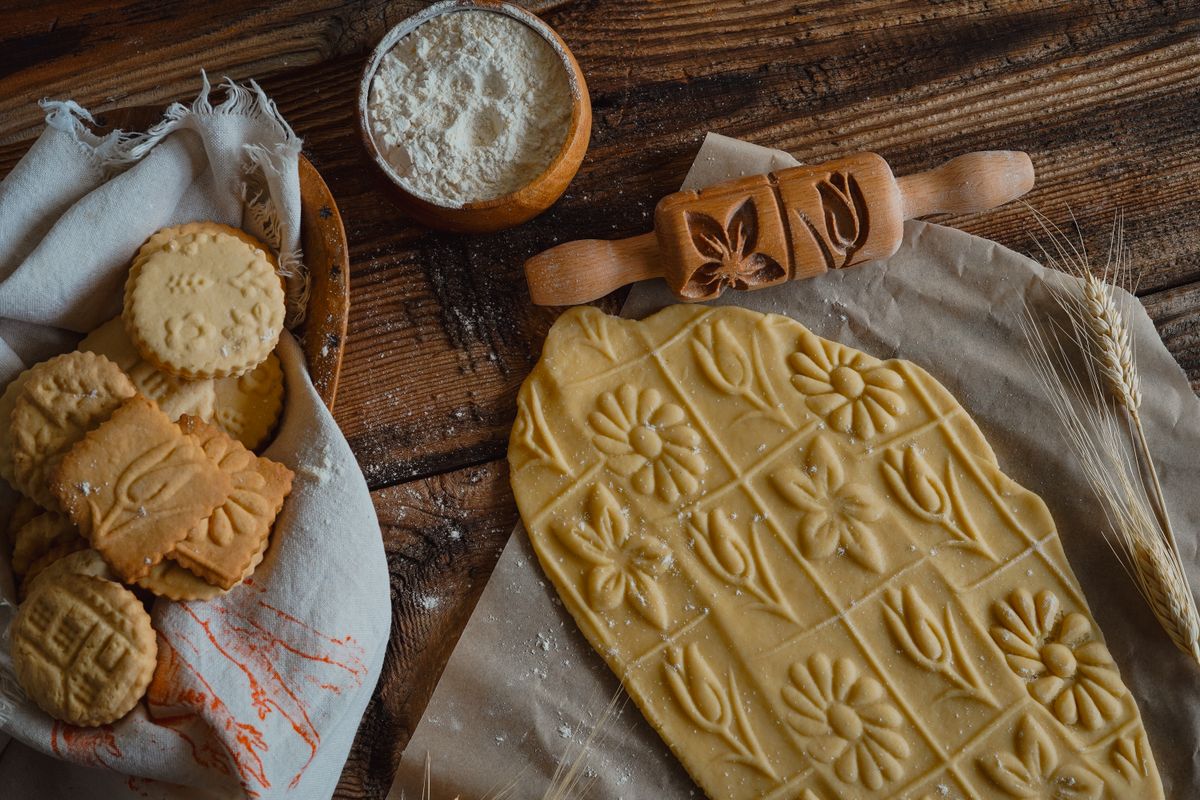
Most lists of einkorn flour recipes are just ordinary recipes with the flour swapped, which is how people end up with flat cookies and a loaf like a doorstop. Einkorn is the oldest cultivated wheat and its gluten is genuinely weak, so the recipes worth making are the ones that never needed a strong gluten network. Order them that way and the flour stops being difficult.
The eight below run from most forgiving to least. If you have one bag and no experience, start at the top.
Quick answer: The best einkorn flour recipes are the ones that do not depend on gluten: shortbread, pancakes, cookies, and pasta all work at 100 percent einkorn with almost no adjustment. Muffins and quick breads work with a little less liquid. Yeasted bread is the hard one, because einkorn is diploid and its gluten tears rather than stretches, so keep it to half the flour and cut the kneading time. Across the board, use about 10 to 15 percent less liquid than the wheat recipe asks for.
Which einkorn flour recipes should you start with?
The ones where gluten was never doing any work. In these three, einkorn’s weakness is invisible and its flavour, sweet, golden and faintly custardy, is the whole point.
1. Einkorn shortbread
The single most forgiving thing you can bake with it. Shortbread wants tenderness and no gluten development at all, which is einkorn’s natural state. Substitute one for one by weight, work the dough as little as possible, and chill it before baking. The colour comes out deeper gold than wheat shortbread and the flavour is noticeably richer.
- 250 g (2 cups) einkorn all-purpose flour
- 170 g (3/4 cup) cold butter, cubed
- 75 g (1/3 cup) caster sugar
- 1/4 tsp fine salt
2. Einkorn pancakes
Batter, not dough, so there is no structure to build. Use a standard pancake recipe and cut the milk by about 15 percent, because einkorn absorbs less liquid than modern wheat and a batter mixed to the usual consistency will spread too thin. Let it rest 10 minutes before cooking.
3. Einkorn chocolate chip cookies
Cookies spread more with einkorn than with wheat, which is a feature if you like a thin, chewy edge and a problem if you want a domed cookie. Chill the dough for at least an hour and the spread comes back under control. This is the recipe that converts people to einkorn flour.
Which recipes need a little more structure?
These three want some framework but not a full gluten network, so einkorn manages with modest adjustments.
4. Einkorn muffins and quick breads
Chemical leavening does the lifting, so the flour only has to hold the crumb together. Reduce the liquid by 15 percent and do not overmix. The crumb is tighter than a wheat muffin and stays moist longer.
- 250 g (2 cups) einkorn all-purpose flour
- 150 g (3/4 cup) sugar
- 2 tsp baking powder
- 1/2 tsp fine salt
- 2 eggs
- 180 ml (3/4 cup) milk
- 80 ml (1/3 cup) melted butter or neutral oil
5. Fresh einkorn pasta
Einkorn makes excellent fresh pasta, which surprises people who have been told it is weak. Fresh pasta wants an extensible dough that rolls thin without springing back, and that is exactly what a gliadin-heavy gluten gives you. Use whole eggs, rest the dough a full hour, and roll it slightly thicker than you would semolina pasta.
6. Einkorn crackers and flatbread
Roll thin, dock with a fork, bake hot. Nothing here needs rise, and einkorn’s flavour carries a plain cracker far better than all-purpose does. A little olive oil in the dough keeps them from going brittle.
Can you make yeasted einkorn bread?
You can, with lowered expectations and two changes. The problem is structural: einkorn is diploid, carrying a single genome where modern bread wheat carries three, per the Wikipedia einkorn wheat entry, and it lacks the genes for the strongest elastic glutenins. The dough tears where wheat dough would stretch.
7. Half-einkorn sandwich loaf
Keep einkorn to 50 percent of the flour and let bread flour do the scaffolding. Knead about two thirds as long as usual and stop while the dough still looks slightly under-developed, because past that point einkorn gluten degrades rather than strengthens. Our einkorn bread recipe works this ratio through properly.
8. Einkorn sourdough
The hardest of the eight and the most rewarding. Long fermentation slackens any dough, so combining it with einkorn compounds the problem: shorten the bulk ferment, handle gently, and bake in a tin if the shaped loaf will not hold. The einkorn sourdough bread guide covers the timing.
How do you convert a wheat recipe to einkorn?
Three adjustments cover almost every case, and they follow from the same property.
- Cut the liquid by 10 to 15 percent. Einkorn absorbs less water than modern wheat, which puts most doughs in the 60 to 68 percent hydration range. Add the reserved liquid back only if the dough or batter refuses to come together.
- Reduce kneading to about two thirds. Einkorn reaches peak strength early, then breaks down. Watch the dough, not the timer.
- Substitute by weight, never by volume. Einkorn flour is lighter per cup, so a volume swap silently under-doses the flour by roughly 10 percent.
None of this is about protein content, which is worth saying because the bags advertise it. Einkorn runs higher in protein than modern wheat in the USDA FoodData Central entries, and bakes worse for structure anyway. Protein percentage predicts almost nothing across wheat species; what matters is which glutenins that protein contains.
For whole-grain bakes, the whole wheat einkorn flour behaves the same way but drinks slightly more water, so start at the 10 percent end of that range rather than 15.
Why do einkorn bakes go flat or greasy?
Usually too much liquid, too much kneading, or butter that was too warm. Flat cookies and slack dough are almost always hydration: the recipe was written for a flour that holds more water than einkorn does, so the batter is wetter than it looks. Greasy shortbread is a temperature problem rather than a flour problem, and einkorn shows it more because the dough is softer to begin with.
If a loaf comes out dense, that is not a fault to fix. It is what 100 percent einkorn does, and it is why the ratios above stop at half.
Where to go from here
If you want the properties behind all of this, our einkorn flour guide covers what the flour is and how it behaves. The einkorn vs spelt comparison is worth reading before you buy, since spelt is the more forgiving of the two heritage wheats and may suit you better. The einkorn wheat profile has the history and nutrition, and spelt is the natural next grain to try, along with the whole berries if you want to cook einkorn rather than bake with it.
Frequently asked questions
Is einkorn flour gluten-free?
No. Einkorn is a true wheat and contains gluten, and it is not safe for anyone with coeliac disease. Its gluten is different in composition, not absent.
Can you substitute einkorn flour one for one?
By weight, yes, in anything that does not need a strong gluten network: cookies, shortbread, pancakes, pasta, crackers. In yeasted bread keep it to about half. Never substitute by volume, because einkorn flour is lighter per cup.
Does einkorn flour need to be refrigerated?
Whole-grain einkorn does, or at least it keeps far better cold, because the germ oils are still present and go rancid within a few months. All-purpose einkorn is more stable but still worth keeping cool if you bake occasionally.
Why is einkorn flour so expensive?
Low yield and hulled grain. Einkorn produces far less per acre than modern wheat and the hull has to be removed in a separate milling step, so the cost per bag reflects genuine agronomy rather than a premium for the label.
Start baking with einkorn
See our hand-picked einkorn, from all-purpose and whole-grain flour to the whole berries.
Shop einkorn →