This einkorn sourdough bread recipe joins the oldest cultivated wheat to the oldest way of raising bread, and the pairing is older than you might guess. Einkorn was domesticated in southeast Türkiye around 10,500 BCE, and wild-fermented loaves were rising in Egyptian bakeries millennia before anyone isolated a yeast. In the years I have spent tracing grain history, this is the loaf I keep coming back to, because it tastes like the reason bread caught on: sweet, golden, and honest. Einkorn’s delicate diploid gluten does demand a different technique from modern-wheat sourdough, but the adjustments are few, and the schedule below makes them automatic.
Quick answer: To make einkorn sourdough bread, mix 400g whole einkorn flour, 260g water, 80g active starter, and 8g salt, bulk ferment 3 to 4 hours with two gentle folds, then cold-proof overnight in the fridge and bake straight from cold in a Dutch oven at 450°F, 25 minutes lidded and 15 to 20 uncovered. Einkorn's weak gluten wants less water, less handling, and a shorter ferment than modern wheat, and the reward is a golden, honeyed crumb. Einkorn is a true wheat, so this loaf contains gluten.
Why is einkorn sourdough different from regular sourdough?
Einkorn (Triticum monococcum) is a diploid wheat, carrying two sets of chromosomes where modern bread wheat carries six, and its small set of gluten proteins never builds the strong, elastic network a modern sourdough leans on. Practically, that means three changes. Use less water, since einkorn absorbs slowly and turns sticky past about 65 to 68% hydration. Handle it gently, because stretching hard tears what little network forms. And watch the clock, because einkorn ferments noticeably faster than modern wheat. None of this is harder; it is just different, the same way our einkorn bread guide describes for the yeasted loaf. The history of this founder crop is a good read while the levain ripens.
How do you make einkorn sourdough bread?
The rhythm is levain the night before, a short bulk ferment with gentle folds, an overnight cold proof, and a hot Dutch oven bake straight from the fridge. Here is the full method.
- 80 g (about 1/3 cup) active einkorn sourdough starter
- 400 g (about 3 1/3 cups) whole einkorn flour
- 260 g (generous 1 cup) room-temperature water (about 65% hydration)
- 8 g (1 1/2 tsp) fine salt
- The night before: ready the levain. Feed your starter with einkorn flour and water so it is active and roughly doubled by morning, 8 to 12 hours later. Our how to feed a sourdough starter guide covers the ratios.
- Mix. Stir the starter into the water, add the einkorn flour and salt, and mix just until no dry flour remains. The dough will feel softer and stickier than modern wheat. That is correct; resist adding flour.
- Bulk ferment, 3 to 4 hours. Give the dough two gentle folds in the first hour (wet your hand, lift one side, fold it over, rotate, repeat). Then leave it alone. It is ready when it has grown by about half and feels airy, never doubled.
- Shape. Turn it out, fold it into a snug round with a light touch, and set it seam-side up in a floured banneton or a towel-lined bowl.
- Cold proof overnight. Cover and refrigerate 8 to 14 hours. The cold firms einkorn’s slack dough, deepens the flavour, and makes scoring far easier.
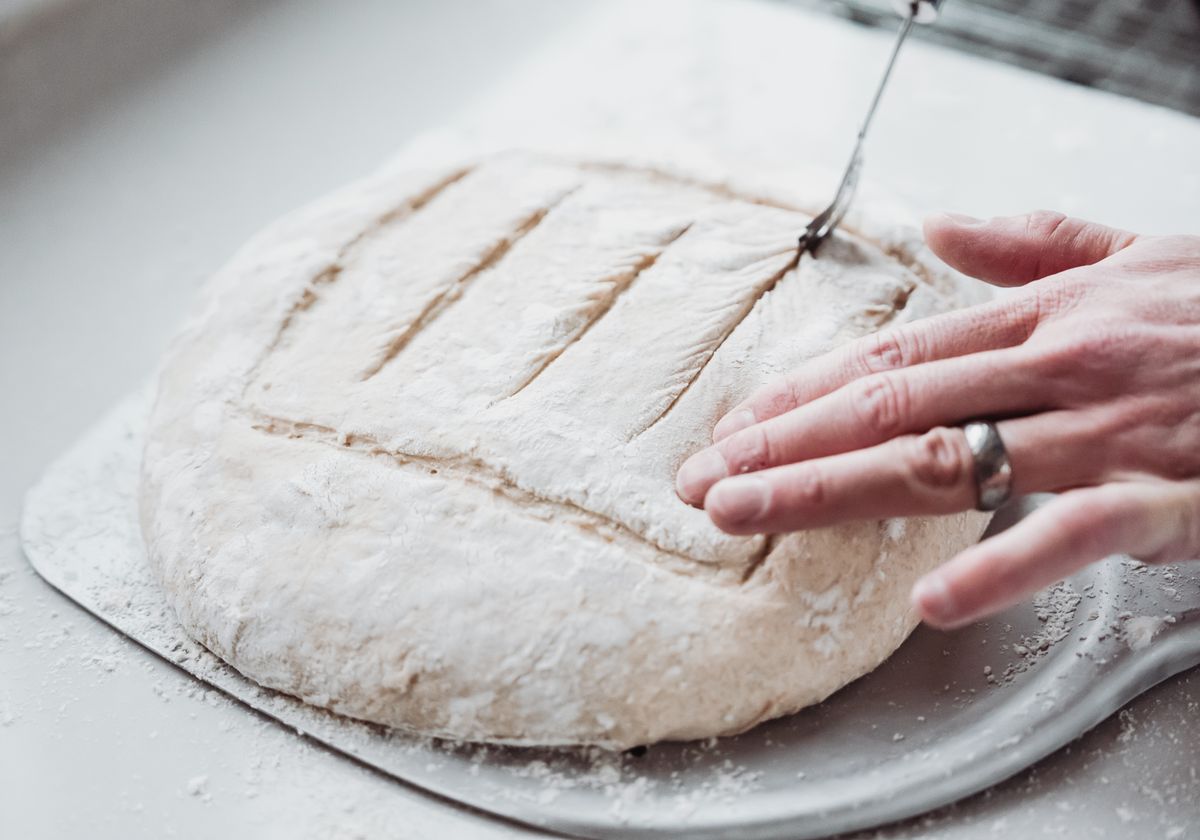
- Bake from cold. Heat a Dutch oven to 450°F for 45 minutes, lower the loaf in on parchment, score it, and bake 25 minutes with the lid on, then 15 to 20 uncovered until deeply bronzed. Cool at least 90 minutes; einkorn sets its crumb as it cools.
Do you need an einkorn sourdough starter?
You need a starter fed with einkorn, but you do not need to build one from scratch. Feed any healthy wheat or rye starter with einkorn flour for two or three cycles and it converts; the wild organisms adapt to the new flour within days. If you have no starter at all, our 7-day starter method builds one, and einkorn takes to it readily because its bran, like rye’s, carries a dense wild-yeast population. Expect an einkorn-fed starter to peak fast and collapse fast, so catch it at the dome. The best flour for a sourdough starter guide compares the feeding flours side by side.
What hydration should einkorn sourdough be?
Start at 65% and treat 68% as the ceiling. This recipe’s 260g of water against 400g of flour sits right in the sweet spot: enough moisture for an open, tender crumb, dry enough that the dough holds a shape. Modern-wheat sourdough habits of 75 to 80% hydration produce einkorn soup, which is the single most common failure. Einkorn also absorbs water slowly, so a dough that feels right at mixing will slacken over the first hour; the cold overnight proof is what pulls it back together. If your kitchen runs hot and the dough spreads anyway, drop to 62% next bake before changing anything else.
Why is my einkorn sourdough flat or gummy?
Flat almost always means over-fermentation or too much water, and gummy means it was cut warm. Einkorn races through its bulk ferment, so a dough left the 5 hours a modern recipe suggests has already peaked and collapsed; watch for the half-grown, airy stage and move on. A loaf that spreads in the oven despite good timing wants less water or a longer cold proof. And einkorn’s moist, golden crumb needs the full 90-minute cool before slicing, because cutting early smears the interior and reads as underbaked. A denser crumb than modern sourdough is not a failure at all; it is the honest texture of a diploid wheat, and it makes exceptional toast.
Where to go from here
If this loaf wins you over, the einkorn shelf runs deep: the einkorn flour guide covers the milling side, the einkorn bread post holds the yeasted version and the flour-buying notes, and the einkorn wheat profile tells the 12,000-year story behind the grain. The same slow method translates to spelt with more water and patience; our spelt vs einkorn comparison lays out how differently the two wheats behave in the bowl. And if you bake without a Dutch oven, the workarounds in our Dutch oven bread guide apply here unchanged. For an independent reference on what real sourdough fermentation involves, the Real Bread Campaign is the one I send people to.
Frequently asked questions
Can you make einkorn sourdough with all-purpose einkorn flour?
Yes. Sifted all-purpose einkorn makes a slightly lighter, paler loaf than whole-grain and absorbs a touch less water, so hold back 10 to 15g of the water at mixing. The method, timings, and temperatures stay the same, and a 50/50 blend of the two is a fine middle path.
Is einkorn sourdough easier to digest?
Some people with mild, non-celiac sensitivity report tolerating it better, and the long ferment plus einkorn’s different gluten profile are the plausible reasons, but the evidence is early and it is absolutely not safe for celiac disease. Einkorn is a true wheat and this is a gluten bread, as our ancient wheats and gluten sensitivity explainer lays out.
Can you blend einkorn with bread flour for more rise?
Yes, and it is the standard training-wheels move. A 50% einkorn, 50% bread flour dough tolerates more water, holds more gas, and bakes taller while keeping most of the golden flavour. Work toward 100% einkorn a bake at a time as your feel for the softer dough grows.
Get the pot that makes the crust
The lidded pot traps the loaf's own steam, which is what gives einkorn its thin, bronzed crust. A 6-quart enameled one is the everyday pick.
Shop Dutch ovens →Bake it with real einkorn
See our hand-picked einkorn, from whole-grain flour to berries, with the brands worth buying.
Shop einkorn →