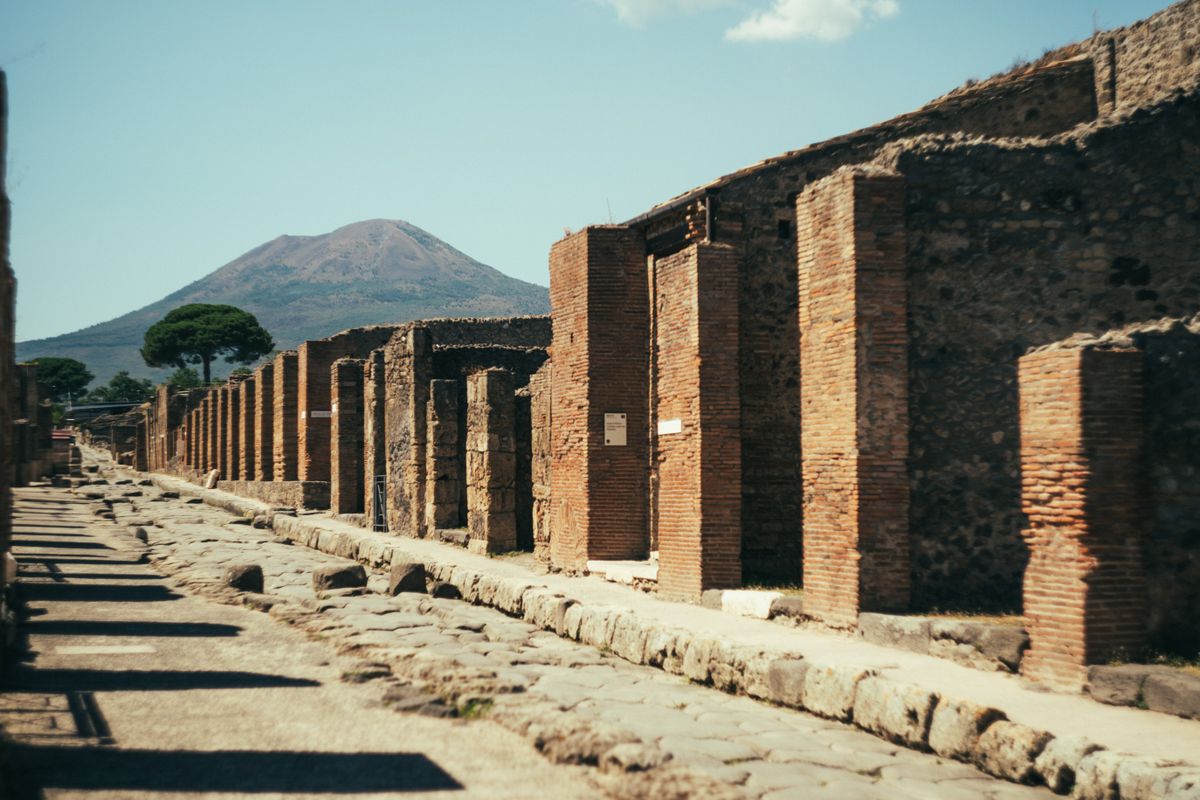
In 1862, excavators at Pompeii opened the oven of a bakery and found 81 loaves still inside, carbonized by the eruption of Vesuvius in 79 AD. Most were the same shape: a round loaf about 20 cm (8 inches) across, pressed into eight wedges, with a groove running around its side. That loaf is what most people mean by Pompeii bread, and it raises an obvious question for anyone who bakes with ancient grains: what was it made from? The answer is less ancient than you might guess, and the story around it takes in emmer porridge, barley, millet leaven, donkey-driven mills and a Roman loaf found in Switzerland this year.
Quick answer: Pompeii bread was made mostly from bread wheat, ground on donkey-driven millstones and sifted into a fine white flour the Romans called siligo. The best-known loaf, the panis quadratus, was a round loaf about 20 cm across, pressed into eight wedges and marked by a groove around its side. Older Roman staples were emmer porridge and barley, and bakers often leavened their dough with sour dough saved from the day before.
What was Pompeii bread made from?
Pompeii bread was made mostly from ordinary bread wheat, Triticum aestivum. When the Bakery of Modestus was excavated in 1862, a small grain mill in the same bakery still held a large amount of unmilled grain, and a study published the next year by De Luca identified all of it as bread wheat. Milled and sifted several times, that wheat became the fine white flour Roman sources call siligo, which is why the loaf is also known as panis siligineus. Archaeologist Farrell Monaco summarizes that evidence in her account of the Modestus loaves.
Monaco has since gone much further. Her chapter in The Bloomsbury Handbook of Experimental Approaches to Roman Archaeology, published in 2025, reverse-engineers the 81 loaves after examining them in person in Naples, covering the flour grade, the grain species and every stage of production from mixing to the oven door. The surprise for ancient-grain fans is that Pompeii’s commercial bread was a sifted bread-wheat loaf, not the emmer and barley foods that came before it.
What grains did the Romans eat?
The grains in Pliny the Elder’s account of Roman food are emmer (far), bread wheat (triticum and siligo), barley (hordeum) and millet (milium). Pliny, who died in the eruption that buried Pompeii, called emmer the first food of the ancient Latins and barley the most ancient food of all, and he describes millet mainly as a base for leaven (Natural History, Book 18, sections 72, 83 and 102).
| Grain | Latin name | How Romans used it |
|---|---|---|
| Emmer | far | Porridge (puls), old rites |
| Bread wheat | triticum, siligo | Fine white bread |
| Barley | hordeum | Barley meal, early breads |
| Millet | milium | Leaven, kneaded with grape must |
Emmer and millet are hulled grains, and Pliny notes they had to be toasted before they could be cleaned, while bread wheat and barley were threshed straight off the floor. That is one practical reason a free-threshing wheat suited a busy bakery. The recipe below uses spelt instead because, of the ancient grains you can buy today, it is bread wheat’s closest relative: it carries the same six sets of chromosomes, so whole spelt flour behaves much like the wheat Pompeii’s bakers milled.
Did ordinary Romans eat bread?
For most of Rome’s history, not much. Pliny wrote that the Romans plainly lived for a long time on porridge rather than bread, and that Rome had no professional bakers until the war with Perseus of Macedon, more than 580 years after the city’s founding, or around 170 BC. Before then, citizens made their own bread at home, and it was mostly women’s work.
Pompeii shows the next step. Archaeologist Nicolas Monteix, who led a project documenting the city’s 39 excavated bakeries, told Archaeology magazine that in the first century BC leavened bread came only from a few large houses with domed ovens. By the first century AD, commercial bakeries had spread across the city, a change he describes as bread becoming available to far more people, even though most Pompeians still ate mainly cereal porridges and the poor rarely had bread.
How did a Pompeii bakery work?
A Pompeii bakery ground its own grain and baked the bread in the same building, and the hardest job, turning the millstones, fell to donkeys and enslaved workers. In December 2023 the Pompeii Archaeological Park announced a bakery in Regio IX that shows exactly how that worked.
The mill room held four tightly packed millstones next to a stable with a long feeding trough. Semicircular grooves carved into the basalt paving kept the blindfolded animals from slipping and held them to a circular path for hours at a time. Following reliefs on the Roman tomb of the baker Eurysaces, the excavators describe each millstone as worked by a pair: a donkey, and an enslaved person who pushed the stone, drove the animal, added grain and collected the flour. The room had no door to the street, only an exit into the house’s atrium, and its few small windows were set high in the wall behind iron bars. The park compares the scene to the second-century novel by Apuleius in which the hero, turned into a donkey, is sold to a miller.
Why are Pompeii loaves cut into eight wedges?
The eight wedges most likely made the loaf easy to break into equal portions, and they were pressed into the dough before baking rather than cut afterwards. Of the 81 loaves from the Bakery of Modestus, 76 have this form, and they average 20 cm across, ranging from 18 to 22 cm.
Monaco’s experiments found that the lines are impressions from a blunt tool, not knife slashes, and her 2025 chapter presents archaeobotanical and experimental evidence that a cord was tied around each loaf to form the groove on its side, and stayed on in the oven. A close cousin turned up at nearby Herculaneum in 1930: a carbonized loaf stamped “Of Celer, slave of Quintus Granius Verus”, now in the National Archaeological Museum of Naples (Wikipedia has the details). A stamp like that marked whose bread it was.
Did Roman bread use sourdough?
Yes, much of it did. Pliny’s leaven of his own day was made from the flour itself, cooked like porridge and left until it turned sour, and he adds that most bakers simply kept back some dough from the day before, which works because sourness is what makes dough ferment. That is a sourdough starter in all but name.
He lists older leavens too. Millet kneaded with grape must kept for a year. Wheat bran soaked in white must for three days made another. Barley-and-water cakes were baked until browned, then left in covered jars until they soured, and barley bread was leavened with the flour of bitter vetch or chickling vetch. In Gaul and Spain, Pliny says, bakers used the foam from beer as leaven, which made their bread lighter than anyone else’s, one more link between bread and the oldest beers in the world.
What is the Roman loaf found in Switzerland in 2026?
It is a small charred loaf from Vindonissa, the Roman legionary camp at Windisch, and the first Roman bread ever found in Switzerland. Archaeologists from the Canton of Aargau announced it in April 2026 after a rescue dig ahead of a housing project.
The loaf lay near a large clay oven built for food production on a big scale. It measures about 10 cm across and 3 cm thick, like a small flatbread, and an archaeobotanist from the University of Basel judged it very likely to be bread. A specialist laboratory in Vienna is now analyzing what it was made from and how it was baked. Until those results arrive, nobody can say which grain the soldiers’ bakers used.
How to bake a Pompeii-style loaf at home
This version keeps the Pompeii loaf’s size, shape and firm dough. Bread flour stands in for the fine siligo, and whole spelt flour adds the nutty, slightly sweet flavor of a hulled wheat; for an older Roman grain, swap in emmer flour at the same weight. A low-hydration dough holds the wedge pattern in the oven. You also need about 30 inches (75 cm) of untreated cotton kitchen twine, a wooden spoon, and a baking stone or a heavy baking sheet.
- 300 g (2 1/2 cups) bread flour
- 200 g (1 2/3 cups) whole spelt flour, or whole emmer flour
- 4 g (1 1/4 tsp) instant yeast
- 10 g (1 3/4 tsp) fine sea salt
- 300 g (1 1/4 cups) lukewarm water
- 8 g (1 tbsp) bread flour, for dusting
- Variant: swap the yeast for 100 g active sourdough starter, cut the bread flour and the water to 250 g each, and allow 4 to 6 hours for the first rise
- Mix the bread flour, spelt flour, yeast and salt in a large bowl, pour in the water, and stir into a shaggy dough.
- Knead on the counter for 10 minutes, until smooth and firm. It should feel stiffer than a sandwich-bread dough.
- Cover the bowl and let the dough rise at room temperature until about doubled, about 1 1/2 hours.
- Shape the dough into a tight ball, then flatten it into a round about 7 inches (18 cm) across and 1 1/2 inches (4 cm) high. Set it on a sheet of parchment, cover, and proof for 45 minutes. Meanwhile, heat the oven to 425°F (220°C) with the baking stone or an upturned heavy baking sheet on the middle rack.
- Tie the twine around the loaf halfway up its side, snug but not tight, and knot it.
- Dust the top with the flour. Press the handle of the wooden spoon straight down across the loaf four times through the center, about 1/2 inch (1.5 cm) deep, to mark eight wedges, then press a small dimple into the middle.
- Slide the loaf on its parchment onto the hot stone and bake for 40 minutes, until deep brown and hollow-sounding when tapped underneath.
- Cool on a rack for 1 hour, then snip off the twine and break the loaf along its wedges.
Serve it the way the shape suggests: torn into wedges and eaten with olive oil, soft cheese, or a bowl of bean or lentil stew.
Where to go from here
For bread even older than Pompeii’s, see the oldest bread in the world, baked from wild grain 14,400 years ago. What is spelt explains the grain in this recipe, and what emmer wheat is covers the Romans’ far. If you want a full sandwich loaf from the same flour, our spelt bread recipe is the next step, and the emmer and spelt pages list the flours worth buying.
Frequently asked questions
What does panis quadratus mean?
It is the modern name for the eight-wedged Roman loaf, taken from a passage in Athenaeus that says the Romans called incised loaves kodratoi. The same loaf is also called panis siligineus, after its fine siligo flour.
Is Pompeii bread gluten-free?
No. It was made from bread wheat, and the spelt and emmer used in modern versions also contain gluten, so it is not safe for anyone with celiac disease.
Was Roman bread white or brown?
Both. Pliny lists flour grades from the finest white down to coarser second-grade and household flours, each yielding its own bread, and Pompeii’s eight-wedged loaves sat at the fine white end.
Bake with the closest cousin of Roman wheat
See our hand-picked spelt, from whole-grain flour to whole berries, with the brands worth buying.
Shop spelt →