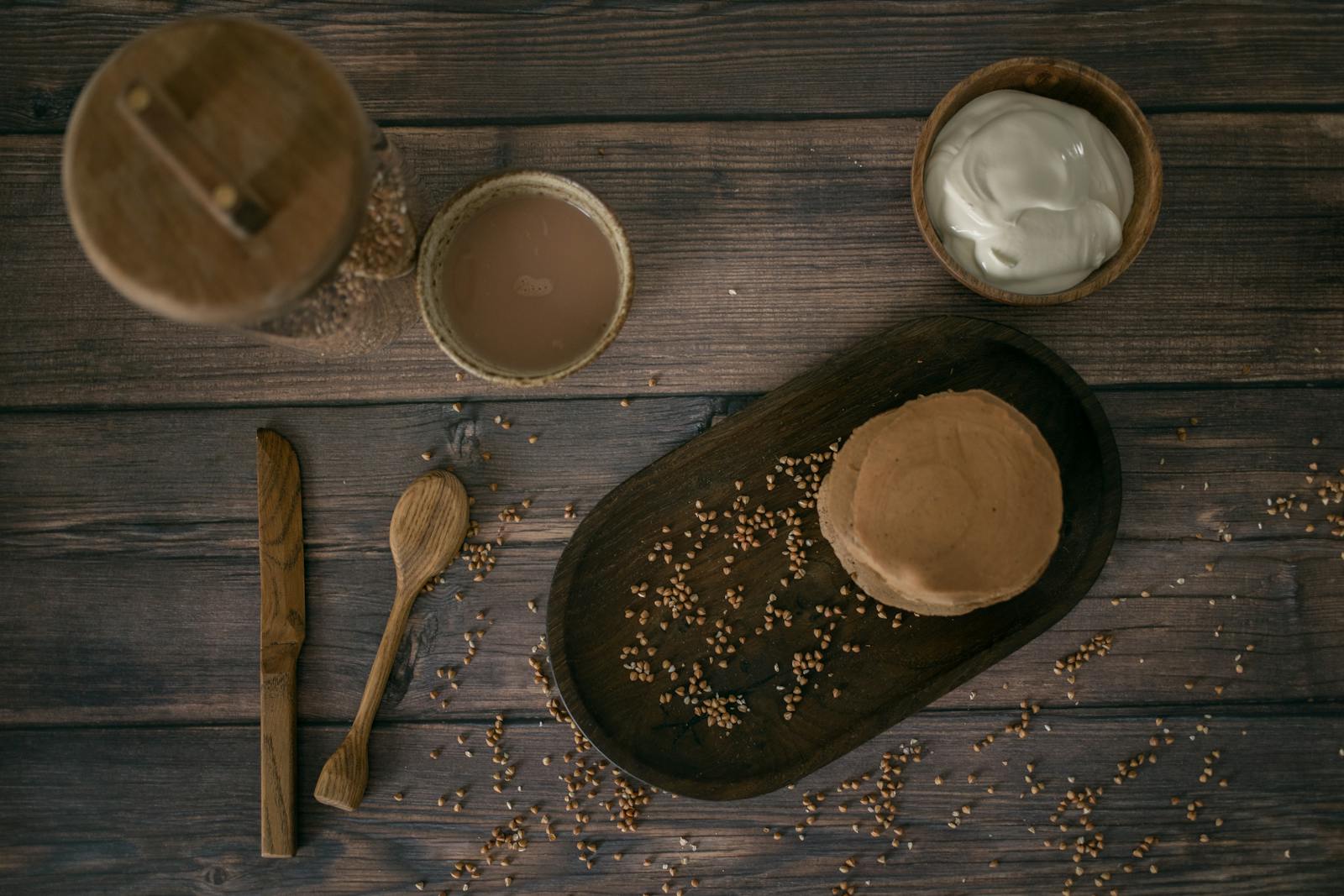
My grandmother grew up outside Minsk, and the first buckwheat pancake recipe I ever cooked came from her hand-written index card, slipped into a Joy of Cooking she gave me when I moved out at 22. The card said “blini” at the top in her neat block letters, then nine ingredients in a column, then a single line at the bottom: “let batter sit.” I have made these pancakes hundreds of times since, and that last line is still the most important. Buckwheat pancakes that work and buckwheat pancakes that fail are usually separated by a 15-minute rest.
This is a foolproof recipe for buckwheat pancakes, scaled for a normal American skillet rather than a Russian griddle, and naturally gluten-free since buckwheat is a pseudocereal, not a wheat. If you’ve ever wondered whether buckwheat is gluten free, our is buckwheat gluten free post handles that explicitly. Short answer: yes, with the usual cross-contamination caveats.
Quick answer: Buckwheat pancakes are naturally gluten-free pancakes made from buckwheat flour, a pseudocereal rather than a wheat, with an earthy, nutty, faintly bitter flavour and a deep russet colour. Whisk buckwheat flour with buttermilk, egg, melted butter, and leavening, then rest the batter 15 minutes so the flour hydrates and thickens, the single step that makes or breaks them. Cook on medium-low until the surface is fully bubbled before flipping. They pair best with fresh fruit or rich, fatty toppings.
What’s the basic buckwheat pancake recipe?
Here is the version I make most weekends. It serves two hungry adults or four people who are eating other things too.
- 1 cup (120 g) whole buckwheat flour, light or dark
- 1 cup (240 g) buttermilk
- 1 large egg (50 g)
- 2 tbsp (30 g) melted butter
- 1 tsp (4 g) baking powder
- 1/4 tsp (1 g) baking soda
- 1/2 tsp (3 g) fine salt
- 1 tsp (6 g) sugar or honey (optional)
- Extra butter, for the pan
Method, in five steps:
- Whisk the dry ingredients (flour, baking powder, baking soda, salt, sugar) in a medium bowl.
- In a separate bowl, whisk the buttermilk and egg together until smooth. Stir in the melted butter.
- Pour the wet into the dry. Whisk just until combined. The batter will look thinner than wheat pancake batter and slightly grey or russet, depending on whether you bought light or dark buckwheat flour.
- Cover and rest the batter at room temperature for 15 minutes. This is the step my grandmother underlined.
- Heat a non-stick skillet or well-seasoned cast iron over medium-low. Brush with butter. Pour 1/4 cup of batter per pancake. Cook until the surface is fully bubbled and the edges look dry (about 3 minutes), then flip and cook another 1.5 minutes. The colour will be a deep russet-brown, not the pale gold of wheat pancakes.
Makes 8 pancakes, roughly 4 inches across.
Why does buckwheat pancake batter need to rest?
The rest gives buckwheat’s slow-absorbing fibre time to hydrate and thicken the batter, and it gives the leavening time to fully activate. Two reasons, both chemistry.
First, buckwheat flour is high in soluble fibre (especially beta-glucan and pectin) that absorbs water slowly. Without a rest, the batter looks thin because the flour hasn’t hydrated yet. After 15 minutes, the same batter is noticeably thicker. If you cook it immediately, the pancakes spread too thin in the pan and tear when flipped.
Second, the leavening reaction between baking powder, baking soda, and acidic buttermilk takes time to fully activate the bubbles. A short rest produces a more even rise.
I have skipped this rest exactly twice in fifteen years of making this recipe. Both times the pancakes were not as good. The rest works.
What does a buckwheat pancake actually taste like?
This is where most first-timers get surprised. Buckwheat pancakes taste very different from wheat pancakes. The flavour reads as earthy, faintly grassy, slightly bitter at the edges, and intensely nutty. The texture is denser than a wheat pancake but more tender than oat or cornmeal. The colour is deep russet brown.
If you have ever eaten a Breton galette (the French savoury crepe made from buckwheat flour), the flavour is similar but drier. If you grew up eating Japanese soba noodles, the flavour is in that family.
People sometimes hate it on the first try and love it on the second. The flavour reads as more complex than wheat, in the way dark rye bread reads as more complex than white. Stick with it.
What are common mistakes when making buckwheat pancakes?
Skipping the rest, cooking too hot, leaving the batter too thick, and flipping too early. After teaching a dozen home cooks this recipe, these are the four mistakes I see most often.
- Skipping the rest. Covered already. Don’t.
- Too high heat. Buckwheat pancakes brown faster than wheat pancakes because of higher residual sugar. Medium-low is the right setting. If your pancakes are dark on the outside and gummy in the middle, the heat is too high.
- Batter too thick. If the rested batter is so thick that it won’t spread when poured, thin it with 2-3 tablespoons of extra buttermilk. The right consistency is a slow, even pour that spreads to ~4 inches without help.
- Flipping too early. Buckwheat pancakes need the surface to look matte and fully bubbled before you flip. If you flip while the surface is still glossy, the batter tears.
What toppings work with buckwheat pancakes?
Buckwheat’s earthy flavour pairs best with sweet-tart and rich-fatty toppings.
| Topping | Verdict |
|---|---|
| Maple syrup | Classic and works |
| Fresh blueberries or blueberry compote | Excellent (the tartness cuts the buckwheat) |
| Banana, sliced | Excellent (the sweetness softens the edge) |
| Sour cream and honey | Russian-traditional and worth trying once |
| Salted butter alone | Very good if the pancakes are fresh |
| Greek yoghurt and honey | Lighter alternative to sour cream |
| Lemon curd | Surprisingly bad (the citrus and earthiness fight) |
| Strawberry jam | Mediocre (too one-note sweet) |
| Orange marmalade | Skip (the citrus oils clash) |
The pattern: anything with rich fat or fresh fruit acidity works. Pure-sweet jams without acid bite tend to flatten the flavour.
Can I use a blender for buckwheat pancake batter?
Yes, and it works well. Add wet ingredients to the blender first, then add dry on top. Pulse 5-6 times until just combined, then pour into a bowl and rest. The blender method produces a slightly silkier batter than hand-whisking. It also tends to over-mix if you blend continuously, which makes the pancakes tougher. Pulse, don’t blend.
A blender shortcut is especially useful if you are doubling the recipe for guests.
How does buckwheat compare to other gluten-free pancake options?
Buckwheat sits in a useful middle ground in the gluten-free breakfast lineup, next to the other two I rotate through.
| Pancake type | Flavour | Texture | Best for | See |
|---|---|---|---|---|
| Buckwheat | Earthy, nutty, complex | Dense, tender | Adults who like strong flavours, fall/winter | this post |
| Oat flour | Mild, oaty, sweet | Light, fluffy | Kids, beginners | Oat flour pancakes |
| Almond flour | Nutty, mild | Eggy, custardy | Low-carb baking | Is almond flour gluten-free? |
If you’re building a gluten-free breakfast rotation, overnight oats is the make-ahead anchor, oat flour pancakes are the kid-friendly weekend option, and buckwheat pancakes are the adult-leaning Sunday brunch. The USDA FoodData Central buckwheat entry puts buckwheat at roughly 343 kcal, 13g protein, and 10g fibre per 100g uncooked, with notably high magnesium and the complete amino acid profile that pseudocereals are known for.
Where does buckwheat fit in the broader grain landscape?
Buckwheat is a pseudocereal in the same conceptual family as quinoa and amaranth, all of which are botanically dicots, not grasses. For the whole-seed side of the plant, our how to cook buckwheat groats guide covers kasha and porridge. The Wikipedia buckwheat entry is solid on the botany if you want the deeper taxonomy. Our quinoa history post covers the parallel story of how a non-grass grain became a cultural staple far from its origin. For the gluten-bearing wheat-family contrast, our emmer vs einkorn piece looks at the heritage wheat side of the spectrum. The categorical distinction matters: buckwheat is closer to rhubarb than it is to wheat, despite the name.
Make these pancakes once and rest the batter properly. That resting rule carries straight over to gluten-free waffles, where it is the difference between a gritty batter and a smooth one. The second batch will be the one that converts you. My grandmother was right about most things in the kitchen, but the underlined line about resting the batter is the one I’d put on the front of any cookbook I ever wrote.
Frequently asked questions
Are buckwheat pancakes gluten-free?
Yes. Despite the name, buckwheat is not wheat but a pseudocereal related to rhubarb, so 100% buckwheat pancakes are naturally gluten-free. Use certified buckwheat flour and gluten-free baking powder if you are strict, since cross-contamination in milling is the only real risk, as our is buckwheat gluten free post explains.
Can you make buckwheat pancakes vegan?
Yes. Replace the egg with a flax egg (1 tablespoon ground flax plus 3 tablespoons water, rested 5 minutes) and use a plant milk soured with a teaspoon of lemon juice or vinegar in place of the buttermilk. The batter still needs its 15-minute rest, and the pancakes cook the same way.
How do you store and reheat buckwheat pancakes?
Cooled pancakes keep in the fridge for about three days and freeze well for up to three months with parchment between them. Reheat straight from frozen in a toaster or a hot dry pan, which crisps the edges better than a microwave, so a weekend batch covers several quick breakfasts.
Stock up on Buckwheat
See our hand-picked Buckwheat, from flour to whole grain, with the brands worth buying.
Shop Buckwheat →