About 10,000 years ago, the people of northern China began growing two small, tough grasses: broomcorn millet and foxtail millet. The first millet farmers worked the dry hills and plains north of the Yellow River, and for years nobody could say who they were. Did hunter-gatherers there start planting millet themselves, or did farmers arrive from somewhere else and bring it with them? A run of ancient DNA studies published in 2026 has finally started to answer that, and the answer says a lot about why millet became one of the great staple grains of Asia.
Quick answer: The first millet farmers lived in northern China. Broomcorn millet was stored in pits at Cishan, in Hebei, between about 10,300 and 8,700 years ago, and starch on grinding stones from Donghulin, near Beijing, shows foxtail millet in use 11,000 to 9,500 years ago. Ancient DNA studies published in 2026 suggest these farmers were local hunter-gatherers who gradually took up millet, not newcomers who brought it with them.
Who were the first millet farmers?
The first millet farmers were the local people of northern China, descendants of hunter-gatherers who had lived there since the end of the last Ice Age. A 2026 study in Science Advances analyzed genomes from seven people buried at Donghulin, Dengcaogouliang and Sitai between 11,000 and 7,300 years ago, and found deep genetic continuity from the Early Holocene right through the rise of millet agriculture. The authors say that supports local development rather than farmers moving in from outside.
The same study turned up a striking side note. A person buried at Donghulin about 9,200 years ago carried the earliest known copy of an EGLN1 gene variant linked to coping with low oxygen, an adaptation now common in Tibeto-Burman populations.
A second 2026 paper, in Current Biology, studied Donghulin on its own and found a previously unknown northern East Asian lineage in a person buried about 11,000 years ago, along with genetic changes at the site over the next 2,000 years. The two papers read the Donghulin population a little differently, one stressing continuity across the region and the other turnover at the site, which is a reminder of how few ancient genomes these conclusions rest on.
Where was millet first domesticated?
Millet was first domesticated in northern China, in what is now Hebei, Beijing and Inner Mongolia. The oldest firm crop evidence comes from Cishan in southern Hebei, where storage pits held husk phytoliths and chemical traces that identify broomcorn millet, dated to between about 10,300 and 8,700 years ago and reported in PNAS in 2009.
| Site | Age | What was found |
|---|---|---|
| Nanzhuangtou, Donghulin | 11,500 to 9,500 years | Millet starch on tools and pottery |
| Cishan, Hebei | 10,300 to 8,700 years | Broomcorn millet in storage pits |
| Xinglong, Simagou | About 8,600 years | Foxtail millet remains |
| Sitai, Yumin | About 7,700 years | Broomcorn and foxtail remains |
Earlier still, starch grains scraped from grinding stones and a pottery sherd at Nanzhuangtou and Donghulin show people processing millet 11,500 to 9,500 years ago, according to a 2012 PNAS study. Its authors suggest foxtail millet was cultivated for about two thousand years while it was slowly being domesticated. The millet remains from Xinglong, Simagou, Sitai and Yumin were recovered by flotation, as China’s Science and Technology Daily reported in October 2026. Most of this early evidence is microscopic, starch and phytoliths rather than whole charred grains, which is why the exact moment wild millet became a true crop is still argued over.
Which came first, broomcorn or foxtail millet?
Broomcorn millet was the first crop grown at Cishan, but foxtail millet was being used elsewhere in northern China at least as early. At Cishan, broomcorn millet was the only grain in the oldest pits, and foxtail millet only appears in small amounts after about 8,700 years ago. The Cishan team called broomcorn millet the earliest dry-farming crop in East Asia and credited its excellent drought resistance. The starch evidence from Donghulin, meanwhile, shows foxtail millet in use more than 9,500 years ago, so the two grains may have been taken up side by side in different places.
Did hunters become millet farmers, or did farmers move in?
Hunters became farmers, slowly, without being replaced. The clearest case is Xinglong in Hebei, where a 2026 Current Biology study sequenced eleven people dated to between 9,000 and 5,000 years ago and measured the carbon and nitrogen in their bones. The same regional ancestry persisted for at least 1,500 years, from 9,000 to 7,500 years ago, while isotopes and plant remains show the community shifting toward millet around 7,500 years ago.
The study’s own conclusion is that the change in diet was not necessarily accompanied by major population replacement. The same October 2026 report describes people on the Bashang plateau, on the Hebei and Inner Mongolia border, living mostly on foraged wild plants about 9,000 years ago, with millet common in meals by 7,500 years ago. The Xinglong study also found that early millet-growing groups across northern China were genetically varied rather than one population spreading out, and that by about 5,500 years ago Xinglong had mixed with the Yellow River millet farmers to the south.
Why did people start growing millet?
Millet suited a dry, unpredictable climate better than anything else people could plant. It needs little water and matures quickly, which is why the Cishan researchers tied its early success to drought resistance, and it is still one of the toughest grains around, as our guide to drought-tolerant grains explains.
Hunting and foraging did not stop overnight. At Yumin, in Inner Mongolia, plentiful bones of wild bison, horses and wild asses suggest that rich hunting grounds eased the pressure to farm full time, and the people there mixed hunting, foraging and some farming for a long time. Millet seems to have started as one part of a wide diet and grown into a staple over thousands of years.
How did millet farming spread south?
Millet spread south partly with people on the move and partly as an idea passed between neighbors. In southwest China, genomes from the Gaoshan and Haimenkou sites, dated 4,500 to 3,000 years ago, show about 90 percent ancestry from Neolithic Yellow River farmers, evidence that millet farmers themselves migrated there, according to a 2023 Current Biology study. The same people grew rice, yet carried no detectable rice-farmer ancestry, so they seem to have picked up rice farming without mixing with rice farmers.
At Baligang, in Henan, where the Yellow and Yangtze worlds meet, a 2025 Nature Communications study of 58 ancient genomes found people already carried both northern and southern ancestry in the early Neolithic. Over the site’s long history the mix of ancestry shifted, but not always in step with changes in pottery or farming, including a shift from rice to millet, which suggests ideas often spread there without big migrations.
Farther south, a 2026 study in Advanced Science compared the Y chromosomes of 14,435 ancient and living people. It found 17 dominant paternal lineages shared between China and mainland Southeast Asia, expanding from about 5,000 years ago and peaking between 3,500 and 3,000 years ago, and concluded that millet farmers, later joined by rice farmers, contributed heavily to the ancestry of southern China and mainland Southeast Asia. A separate 2026 Y-chromosome study in Science Advances also found several southward migrations of Neolithic Chinese farmers.
Is the millet you buy today the same crop?
Yes, both of the first millets are still grown and sold. Broomcorn millet is the species Panicum miliaceum, sold as proso or common millet, and the plain whole grain millet in most American stores is usually proso. Foxtail millet is Setaria italica, still widely eaten in China and India, and harder to find in Western stores, though foxtail millet is easy to buy online.
Proso cooks in 15 to 20 minutes, and our guide on how to cook millet covers the fluffy and creamy versions. A bowl of plain millet porridge is about as close as you can get to the meal those first farmers ate.
Where to go from here
For the botany behind the names, see what millet is and the types of millet guide, which sorts proso, foxtail, pearl and finger millet. For a parallel story from the other side of the world, the oldest bread in the world shows wild wheat and barley being baked thousands of years before farming in the Near East.
Frequently asked questions
Is millet gluten-free?
Yes. Broomcorn and foxtail millet are both naturally gluten-free, though anyone with celiac disease should buy millet labeled certified gluten-free, since it can pick up wheat in fields and mills.
What is the difference between broomcorn and foxtail millet?
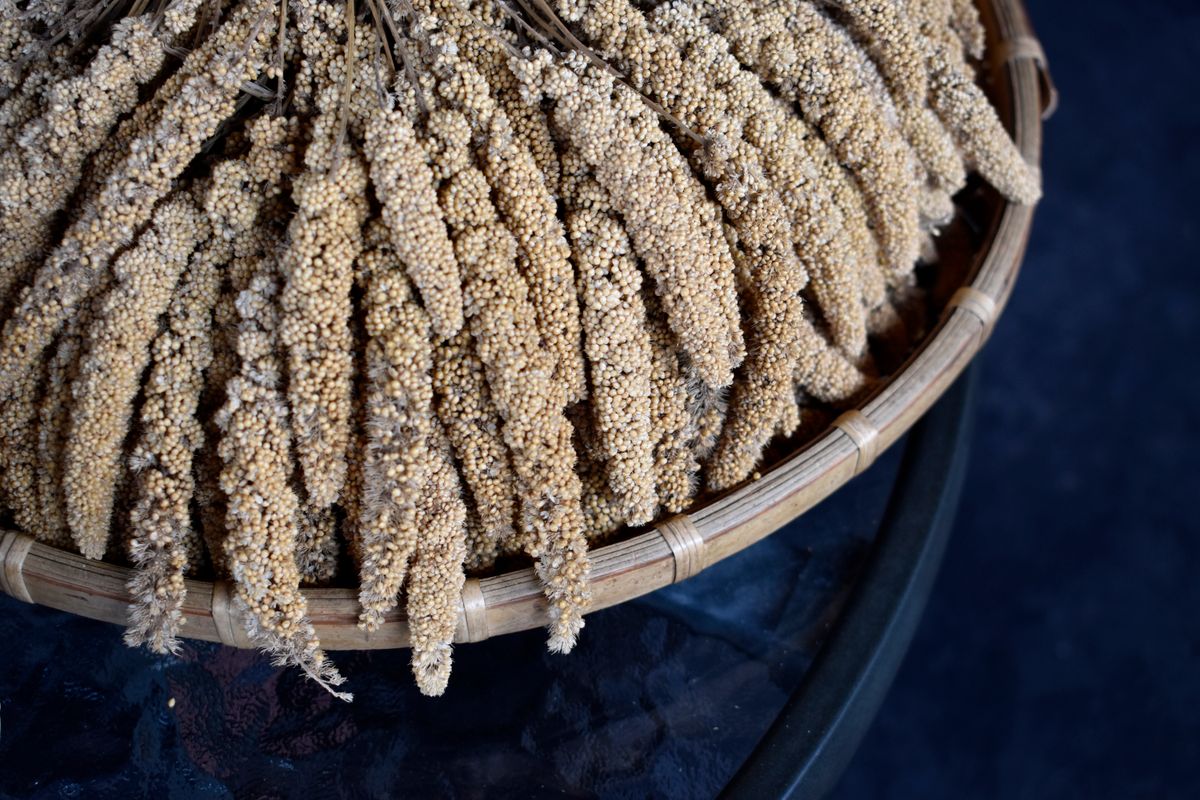
They are different grasses. Broomcorn (proso) millet has round, pale seeds in a loose, drooping head, while foxtail millet has smaller seeds packed into a dense, bristly head shaped like a fox’s tail.
What did the first millet farmers eat besides millet?
Mostly what they hunted and gathered. The early millet communities of northern China kept hunting game such as wild bison and horses and foraging wild plants for thousands of years, and millet only became the main food gradually.
Cook the grain that fed early China
See our hand-picked millet, from whole grain to flour, with the brands worth buying.
Shop millet →