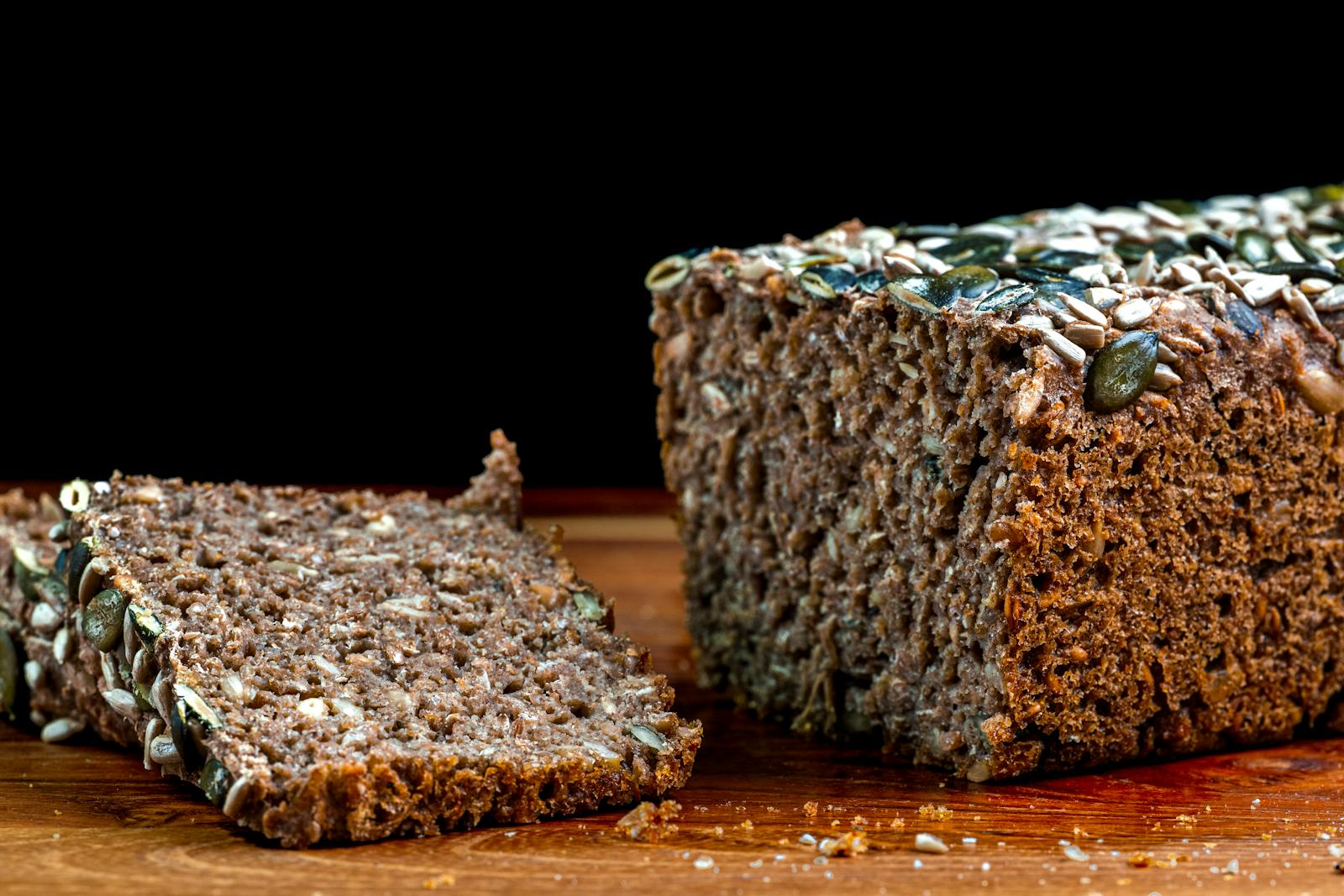
The bread I bake most weeks is whole grain rye bread, the dense, seedy Danish rugbrød my grandmother kept in a tin on the counter and sliced thin every morning for the next ten days. It is not the 30% rye marble loaf you find at most American bakeries. It is heavier, darker, slower to make, and so much better that I find it hard to go back. If you have only ever met rye as a thin slice in a deli sandwich, this is a different bread entirely.
A true whole grain rye loaf is 80-100% rye flour, often with cracked rye berries (called rye chops; cooking whole rye berries is its own simple guide) and seeds mixed through the dough, fermented with a rye sourdough starter for one to two days. It bakes in a loaf pan because the dough is too slack to hold a free-form shape. The reward is bread that keeps for two weeks at room temperature, slices like a dream, and tastes more like itself the older it gets. This contains gluten, by the way; if you came here for the gluten-free question, see our is rye bread gluten free post for the unambiguous answer.
Quick answer: Whole grain rye bread is a dense, seedy loaf made from 80 to 100% rye flour, fermented with a rye sourdough starter over one to two days and baked in a loaf pan. Rye's weak gluten and high pentosans make the "dough" a thick batter you stir rather than knead, so expect a modest rise and a moist, sliceable crumb, not an airy one. The sourdough acids and dense crumb let it keep for up to two weeks. Rye contains gluten, so this bread is not gluten-free.
What makes whole grain rye bread different from regular rye?
Most “rye bread” sold in North America is actually 20-30% rye flour blended with bread flour, which gives you the colour and a hint of the flavour without the texture or the keeping qualities. True whole grain rye is closer to 100% rye and bakes very differently.
| Bread style | Rye content | Texture | Shelf life |
|---|---|---|---|
| Deli rye / marble rye | 20-30% rye + bread flour | Light, sandwich-friendly | 3-5 days |
| German Vollkornbrot | 80-100% rye, often whole grain | Dense, sliceable | 7-10 days |
| Danish rugbrød | 80-100% rye plus cracked rye and seeds | Very dense, seed-studded | 10-14 days |
| Russian borodinsky | ~80% rye, often with molasses and coriander | Dense, slightly sweet | 7-10 days |
| Pumpernickel (traditional) | 100% rye, very dark | Almost cake-like | 10-14 days |
This recipe is closest to the Danish rugbrød in spirit. The dough is wet enough to look like batter, the loaf is pan-baked, the seeds are central not decorative, and the bread is meant to be sliced very thin and stacked with toppings.
Why does rye dough behave so differently from wheat dough?
Rye contains gluten (secalin and a glutelin fraction) but in a different ratio and structure than wheat. The gluten that does exist forms a much weaker network, and the high pentosan and arabinoxylan content of rye absorbs huge amounts of water. The combined effect: rye dough is not really a dough at all in the wheat sense. It is a thick, sticky batter that you stir with a wooden spoon, not knead with your hands.
A few practical consequences:
- No kneading. Stretching only breaks the fragile gluten and produces a denser loaf.
- The dough rises slowly and modestly. Expect maybe 1.5x not 2x.
- Loaf pans are required. Free-form loaves sink and spread.
- The crumb is dense and slightly moist by design. A rugbrød should never feel airy.
For the underlying flour-handling questions, our rye flour post is the practical companion. For the broader sourdough-starter context (rye is the best flour for building a starter from scratch), see our best flour for sourdough starter post.
The recipe: 100% whole grain rye sourdough
Makes one Pullman-pan loaf (about 1.2 kg / 2.5 lb), bakes in 24 to 48 hours from start to finish. The base is a good wholemeal rye flour, and everything else builds on it.
- 500 g (4 to 4 1/2 cups) whole rye flour: 100 g for the levain, 400 g for the dough
- 50 g (1/4 cup) active rye sourdough starter
- 450 g (scant 2 cups) lukewarm water: 100 g for the levain, 350 g for the dough
- 150 g (scant 1 cup) cracked rye berries (rye chops), pre-soaked, plus their soaking water
- 150 g (about 1 cup) mixed seeds (sunflower, pumpkin, flax, sesame), toasted
- 12 g (2 tsp) fine sea salt
- 15 g (2 1/4 tsp) molasses or barley malt syrup, optional
The rhythm, start to finish:
- Day 1, evening. Mix the levain (starter, 100 g rye flour, 100 g water), cover, and leave overnight, 8 to 12 hours.
- Day 2, morning. Stir the levain, remaining flour and water, soaked rye chops, seeds, salt, and molasses into a thick porridge-like batter.
- Pan it. Scrape into a buttered Pullman or 9x4 inch loaf pan, smooth the top with a wet spatula, and scatter extra seeds over.
- Proof. 4 to 6 hours at warm room temperature, until risen 30 to 50 percent, with cracks showing on the surface.
- Bake. 20 minutes at 425°F covered with foil, then 60 to 75 minutes at 350°F uncovered, to an internal 210°F.
- Cure. Turn out, wrap in a tea towel, and wait a full 24 hours before the first slice.
Each stage in detail:
Day 1, evening (build the levain):
| Ingredient | Weight |
|---|---|
| Active rye sourdough starter | 50g |
| Whole rye flour | 100g |
| Water (lukewarm) | 100g |
Mix, cover, and leave at room temperature 8-12 hours overnight.
Day 2, morning (mix the dough):
| Ingredient | Weight |
|---|---|
| The levain from above | 250g |
| Whole rye flour | 400g |
| Cracked rye berries (rye chops), pre-soaked in water | 150g (dry weight) plus soaking water |
| Mixed seeds (sunflower, pumpkin, flax, sesame), toasted | 150g total |
| Water (lukewarm) | 350g, adjusted to dough feel |
| Fine sea salt | 12g |
| Optional: 2 1/4 tsp molasses or barley malt syrup | 15g |
Stir together in a large bowl with a wooden spoon until evenly combined. The mixture will look like thick porridge, not dough. Scrape into a buttered Pullman pan or 9x4 inch loaf pan, smooth the top with a wet spatula, scatter a few extra seeds on top, and cover loosely with plastic.
Day 2, afternoon-evening (proof):
Leave at warm room temperature (20-22°C / 68-72°F) for 4-6 hours. The dough should rise about 30-50%, never doubling. Surface cracks are normal and a good sign.
Day 2, evening (bake):
Preheat oven to 425°F (220°C) for at least 30 minutes. Bake the loaf, covered with foil, for 20 minutes, then reduce to 350°F (175°C), uncover, and bake another 60-75 minutes. Internal temperature should hit 99°C / 210°F. The loaf will sound hollow when tapped.
Day 2-3, overnight (cure):
Turn the loaf out of the pan immediately, wrap in a clean tea towel, and leave 24 hours before slicing. This is critical: a fresh-cut rugbrød is gummy. The full crumb structure develops as the bread cools and the moisture redistributes.
Why does whole grain rye bread keep so long?
The sourdough acids keep mould at bay, and the dense moist crumb keeps the loaf from drying out. Both come down to biology.
- Low pH from rye sourdough. The acetic and lactic acids from a long ferment drop the bread’s pH to around 4.0-4.3, which is hostile to most mould species. Wheat sourdough is similar but slightly less acidic.
- Dense, moist crumb traps moisture evenly. Where a light wheat loaf goes stale in 2-3 days as it dries out, a rugbrød holds its moisture and texture for 10-14 days at room temperature, wrapped in a tea towel.
The Danish habit is to bake one loaf a week and slice from it through Saturday. This is genuinely practical bread for a household, not a weekend project that gets eaten in two sittings.
How do you eat whole grain rye bread?
Thin slices, generous fat, savoury toppings. The Nordic smørrebrød (open-face sandwich) tradition is the canonical way to use this bread. Here are a few classics from my grandmother’s kitchen.
| Topping | What goes on it |
|---|---|
| Smoked salmon | Salmon, dill, capers, a slice of cucumber |
| Pickled herring | Herring, sliced raw red onion, a wedge of hard-boiled egg |
| Liver pâté | Pâté, pickled beets, fried onions |
| Egg | Sliced hard-boiled egg, shrimp, mayonnaise, dill |
| Cheese | Aged cheddar or Havarti, thin apple slices, a smear of mustard |
| Butter and chocolate | Salted butter, dark chocolate shavings, a Danish child’s snack |
A rugbrød is not a sandwich bread; it is a platform. Cut slices half a centimetre thick at most, butter generously, and add one or two toppings, not five.
What if I need a gluten-free dark bread alternative?
The closest gluten-free analogues to rugbrød are dense buckwheat or sorghum loaves built around seeds and long ferments. Neither matches the secalin-driven keeping qualities of rye, and neither carries the exact flavour profile, but both are honest dark breads in the same spirit. Our gluten-free grains hub covers the broader pantry for readers who cannot eat rye. For heritage-wheat options with milder gluten profiles (still not GF, just sometimes better tolerated by NCGS), see the emmer vs einkorn comparison, the einkorn bread post, and the spelt grain page for the other hexaploid heritage wheat that bakes more like a modern loaf.
The Whole Grains Council rye page covers the broader history of rye as a staple grain. For the nutrition numbers, the USDA FoodData Central rye flour entry puts whole rye flour at roughly 338 kcal, 10g protein, and 15g fibre per 100g, which is genuinely outstanding fibre content for a bread flour.
Bake one loaf, slice it thin starting on day two, and eat through it for a week. By the end of the week you will understand why most of northern Europe never moved on from this bread.
Frequently asked questions
Is whole grain rye bread gluten-free?
No. Rye is a close cousin of wheat and contains gluten (secalin), so whole grain rye bread is not safe for anyone with celiac disease. Sourdough fermentation lowers the gluten slightly but nowhere near a safe level, as our is rye bread gluten free post explains in full.
Can you make whole grain rye bread without a sourdough starter?
You can, but sourdough is strongly preferred. A yeasted 100% rye loaf works, yet it bakes denser and stickier and keeps far less well, because rye needs the acidity of a sourdough to set its crumb and hold off mould. If you have no starter, a splash of vinegar or buttermilk mimics some of that acidity, though the result is a compromise.
Is rye bread healthier than wheat bread?
Whole grain rye is one of the highest-fibre bread grains, with roughly 15g of fibre per 100g of flour and a lower glycemic impact than most wheat bread, so it keeps you full longer and steadies blood sugar. It is still a gluten-containing bread with real carbohydrates, but nutritionally it is a genuine step up from white wheat bread.
Stock up on Rye
See our hand-picked Rye, from flour to whole grain, with the brands worth buying.
Shop Rye →