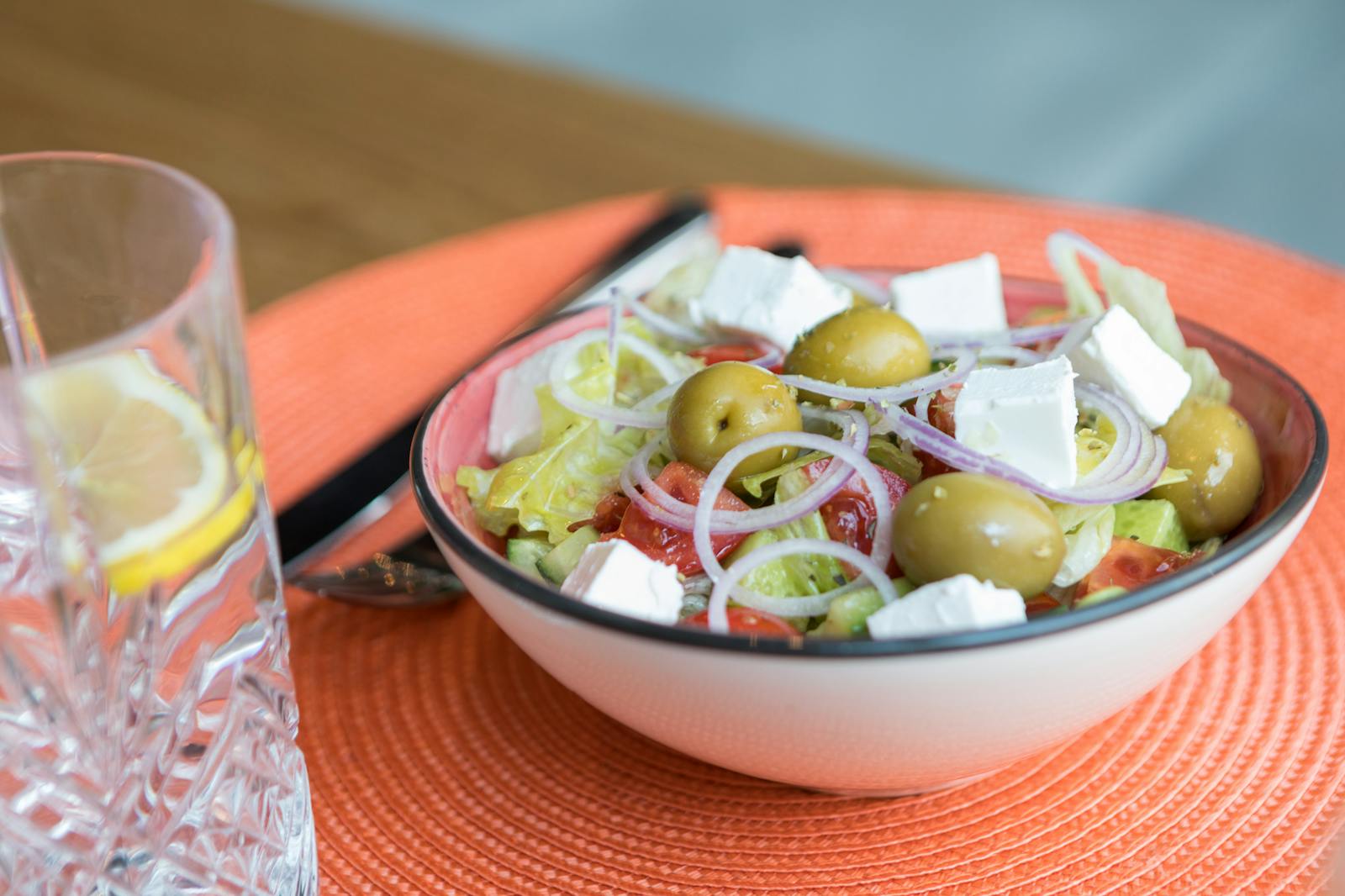
Before I give you the recipe, an honest historian’s note: Greek quinoa salad is not a traditional Greek dish. Quinoa is Andean, domesticated thousands of years ago in the highlands of Peru and Bolivia, and it did not arrive in European kitchens until the late 20th century. What we call Greek quinoa salad is a contemporary fusion, a New World pseudocereal dropped into an Old World flavour profile. It works because the quinoa carries the brine and acid of a real Greek salad better than most other grains can, and because it is naturally gluten-free in a way the traditional bulgur tabbouleh is not.
I have spent enough years writing about Mediterranean food traditions to be careful about labelling things “Greek.” This is not one of those traditions. It is a useful, delicious modern invention, and the version below is the one I make most often for guests who need to eat gluten-free. Treat it as homage, not as authenticity.
Quick answer: Greek quinoa salad is a modern gluten-free fusion, not a traditional Greek dish: it drops Andean quinoa into the flavours of a classic horiatiki salad. Cook the quinoa dry and cool it fully, then toss with cucumber, tomatoes, red onion, kalamata olives, and brined feta in an oregano, red-wine, and lemon vinaigrette. The cooled grain absorbs the dressing without going mushy and holds for two days. Quinoa makes it naturally gluten-free, unlike a bulgur tabbouleh.
What goes in a proper Greek quinoa salad?
Quinoa, cucumber, tomatoes, red onion, kalamata olives, brined feta, and fresh herbs, in an oregano, red-wine, and lemon vinaigrette. The list maps closely to a classic Greek horiatiki salad, with quinoa replacing the absent grain and a few small adjustments to the dressing.
- 1 cup (170 g) dry quinoa, white, red, or tri-color
- 2 cups (480 ml) water or vegetable broth
- 1/2 tsp fine salt, for the quinoa
- 200 g English cucumber, diced (about 1.5 cups; roughly 2/3 of one large)
- 1.5 cups (250 g) cherry or grape tomatoes, halved
- 1/3 cup (50 g) red onion, fine dice
- 1/2 cup (80 g) kalamata olives, pitted and halved
- 3/4 cup (100 g) feta cheese in brine, crumbled
- 1/3 cup (20 g) flat-leaf parsley, chopped
- 2 tbsp (8 g) fresh mint, chopped
- 1/4 cup (60 ml) extra-virgin olive oil
- 2 tbsp (30 ml) red wine vinegar
- 1 tbsp (15 ml) fresh lemon juice
- 1 tsp dried Greek oregano
- Fine sea salt and black pepper, to taste
The combination is non-negotiable on a few points. Kalamata, not generic black olives. Feta in brine, not the dry crumbly American version. Greek dried oregano, ideally from a single-origin importer, because the flavour difference is real. The rest of the salad is forgiving; the brand of olives, feta, and oregano is not.
How do you cook quinoa for a salad?
This is where most home recipes go wrong, so it is worth being precise. Quinoa for a salad must be cooked dry, not creamy, and cooled completely before mixing. Warm quinoa weeps moisture, dilutes the dressing, and turns the salad sad within an hour.
The method I use:
- Rinse 1 cup of dry white quinoa under cold water for 20 seconds in a fine sieve, to remove residual saponin bitterness.
- Toast the rinsed quinoa in a dry saucepan over medium heat for 3-4 minutes, stirring, until it smells nutty and a few grains pop. This is the single biggest flavour upgrade and the step most recipes skip.
- Add 2 cups of cold water or broth and 1/2 teaspoon salt. Bring to a boil, drop to a low simmer, cover, cook 15 minutes. Do not stir.
- Off the heat, leave covered for 10 more minutes.
- Fluff with a fork. Spread on a sheet pan to cool completely (about 20 minutes at room temperature, or 10 minutes in the fridge).
- Whisk the olive oil, red wine vinegar, lemon juice, oregano, and a pinch of salt and pepper into a dressing.
- Toss the cooled quinoa with the cucumber, tomatoes, onion, olives, parsley, and mint. Pour the dressing over, toss again, then fold in the feta last so it stays in whole crumbles. Rest 10 minutes and taste for salt before serving.
The build order matters: the cool quinoa absorbs the vinaigrette without going mushy, and the salad holds for two days in the fridge instead of one.
Why use quinoa instead of bulgur?
Because quinoa is gluten-free where bulgur is not, and because it is a complete protein. There are two reasons, both worth spelling out.
- Gluten-free. Traditional tabbouleh uses bulgur, which is durum wheat and contains gluten. For anyone with celiac disease or non-celiac gluten sensitivity, the bulgur version is off-limits, and our is sourdough bread gluten free and is quinoa gluten free explainers cover why the distinction matters. Quinoa is one of the most reliably gluten-free grains.
- Complete protein. Quinoa carries all nine essential amino acids, which is unusual for a plant food. A bowl of this salad is genuinely meal-substantial in a way that a bulgur tabbouleh is not. Our quinoa history post explains why Andean cultures built a complete diet around it.
The flavour trade-off is real but small. Bulgur is wheatier and chewier; quinoa is faintly grassy and tender. In a salad this assertive, with feta, olives, and lemon doing most of the work, the substitution disappears into the flavour profile.
What is the right dressing for a Greek salad?
The Greek classic, horiatiki (the Wikipedia entry on Greek salad covers its evolution), is the simplest of vinaigrettes: olive oil, red wine vinegar, oregano, salt, pepper. Many modern recipes add lemon juice (I do), some add a touch of Dijon (I don’t), and almost none should add garlic, despite American assumptions. Greek horiatiki dressing is a pure expression of olive oil quality.
Use the best extra-virgin olive oil in your kitchen for this dressing. The single bottle you splurged on, the one you save for finishing pasta and dipping bread, is the right bottle. The salad will not work as well with neutral oil or a budget olive oil; the dressing is too small a quantity to hide cheap fat.
Roughly 4 parts oil to 3 parts acid (1/4 cup oil to 2 tablespoons vinegar plus 1 tablespoon lemon) is the proportion that lets the dressing coat without overwhelming the salad. Greek oregano, dried, is preferable to fresh because the dried herb releases its volatile oils into the dressing as it sits.
How do I make this ahead?
Either store the components separately and dress just before serving, or assemble fully and hold it dressed for up to two days. Both patterns work well.
- Make-ahead, store-ahead, dress-fresh. Cook the quinoa and chop the vegetables up to two days in advance. Store quinoa, vegetables, and dressing separately in the fridge. Mix within 30 minutes of serving.
- Make-ahead, dressed. A fully assembled Greek quinoa salad holds for two days in the fridge if the cucumber is patted dry before adding. Beyond two days, the cucumber weeps and the salad turns watery.
For meal prep, I prefer the first method, since the salad tastes most vibrant in the first hour after dressing.
What do I serve with Greek quinoa salad?
Grilled chicken or fish, hummus and warm pita, lemon-roasted broccoli, or use it as a stuffing for roasted peppers or grape leaves. Here are a few honest pairings.
- Grilled chicken or fish. Lemon-oregano grilled chicken thighs or a piece of bronzed branzino are the obvious Mediterranean partners.
- Hummus and warm pita. Use a certified gluten-free pita or skip if avoiding gluten.
- A simple lemon-roasted broccoli. The brightness mirrors the salad without competing.
- As a stuffing for roasted peppers or stuffed grape leaves. The salad-as-stuffing trick is one of the best ways to use leftovers.
For the broader gluten-free recipe rotation that this salad fits into, our millet recipes roundup covers another grain that works in the same Mediterranean profile, the gluten-free grains hub maps the full set of safe grains, and the emmer vs einkorn explainer covers the heritage-wheat side of the comparison (the ancestors of bulgur, which traditional tabbouleh is made from and which are not gluten-free). For the nutrition numbers behind the recipe, the USDA FoodData Central quinoa entry puts cooked quinoa at roughly 120 kcal and 4.4g protein per 100g, and our quinoa vs rice comparison shows how that stacks up against the default grain. The complete pseudocereal context lives in our amaranth grain page if you want to substitute or extend the salad with a different Andean grain.
Make it once with proper Greek oregano and a brined feta and the salad will earn a rotation slot. The historian in me will keep gently pointing out that it isn’t really Greek; the cook in me will keep making it every week through tomato season.
Frequently asked questions
Is Greek quinoa salad gluten-free?
Yes. Because it is built on quinoa rather than the bulgur of a traditional tabbouleh, this salad is naturally gluten-free and safe on a gluten-free diet. Just check that the feta and any add-ons are gluten-free, and serve it with certified gluten-free pita if you want bread alongside.
Is Greek quinoa salad healthy?
Very. Quinoa is a complete protein, the vegetables and olive oil bring fibre and heart-healthy fats, and the whole bowl is nutrient-dense enough to stand as a light main. The main thing to watch is sodium from the feta and olives, so salt the dressing lightly and taste before adding more.
Can you make Greek quinoa salad vegan?
Yes. Leave out the feta or swap in a plant-based feta, and the salad still works, since the quinoa, vegetables, olives, and herbs carry it. Add a handful of chickpeas or extra olives for the savoury, briny note the cheese would have provided, or go all the way to our quinoa chickpea salad, which is vegan-ready as written.
Stock up on Quinoa
See our hand-picked Quinoa, from flour to whole grain, with the brands worth buying.
Shop Quinoa →